Aerosols are microscopic particles suspended in air, measured in micrometers (microns). According to the EPA, a human hair is about 70 microns wide — roughly 30 times larger than the largest fine particle classified as PM2.5. The particles that pose the greatest health risk are ones you'll never see.
This article breaks down what aerosol particle size means, how each size category affects your health, and what it takes to actually filter the most dangerous particles from your indoor air.
Key Takeaways
- Aerosol particle size, measured in microns, is the primary factor determining health risk
- Three main categories exist: Coarse (PM10), Fine (PM2.5), and Ultrafine (PM0.1) — smaller means more dangerous
- Fine and ultrafine particles bypass your body's natural defenses, penetrating deep lung tissue and the bloodstream
- Standard air filters are ineffective against particles smaller than 0.3 microns
- ECOairflow's Electronic Polarization Technology (EPT) captures ultrafine particles down to 0.001 microns — where standard filters fail
What Is Aerosol Particle Size and Why Does It Matter?
An aerosol is a suspension of fine solid or liquid particles in a gas. Think of dust motes drifting through a sunbeam, or the faint haze above a burning candle — those are aerosols you can actually see. The particles that cause the most harm are invisible to the naked eye.
"Particle size" refers to the diameter of these suspended particles, measured in micrometers (µm). A human hair is roughly 70 microns wide — the most dangerous particles are more than 28 times smaller than that single strand.
Why Size Controls Everything
Two physical behaviors are determined almost entirely by particle size:
- Suspension time: Smaller particles are so light they barely respond to gravity. A peer-reviewed study found that a 1-micron particle takes approximately 8 hours to settle just one meter in still air. In a real home with air currents, ultrafine particles can stay airborne for days — continuously available for inhalation.
- Penetration depth: Where a particle lands in your respiratory system depends almost entirely on its size. Larger particles get filtered out in your nose and throat; smaller ones travel deeper. The smallest bypass the lungs entirely and enter your bloodstream.
Understanding the Range: From Coarse to Ultrafine Particles
Coarse Particles (PM10)
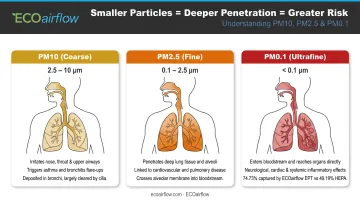
PM10 refers to particles between 2.5 and 10 microns in diameter. Common examples include:
- Road dust and construction debris
- Pollen and mold spores
- Dust mite particles
The body handles these relatively well. They tend to deposit in the upper respiratory tract — nose, throat, and larger airways — where mucus and cilia can trap and remove them. They cause irritation, aggravate asthma, and trigger allergies, but they rarely enter systemic circulation.
Fine Particles (PM2.5)
PM2.5 particles are smaller than 2.5 microns. They come primarily from combustion — vehicle exhaust, industrial emissions, wildfire smoke, gas stoves, and burning candles. At this size, the body's upper-airway defenses fail. These particles slip past the nose and throat and penetrate deep into the bronchioles and alveoli, where oxygen exchange occurs.
The American Heart Association has directly linked PM2.5 exposure to increased risk of heart attack, stroke, arrhythmia, and heart failure. The danger is systemic, as inflammation triggered in the lungs can cascade throughout the cardiovascular system.
Ultrafine Particles (PM0.1)
Ultrafine particles (UFPs) are smaller than 0.1 microns — or 100 nanometers. They don't just penetrate deep into the lungs—they can pass directly through the alveolar walls and enter the bloodstream.
A 2024 Nature Scientific Data study estimates that UFPs account for a global mean of 91% of total particle number concentration, with urban environments consistently exceeding 90%. They dominate the air by count, even when they're barely detectable by mass.
Sources include high-temperature combustion from vehicle engines and gas stoves, as well as tobacco smoke. To put this in perspective, individual viruses like influenza and SARS-CoV-2 fall into this size range, measuring approximately 60–140 nanometers.
How Aerosol Particle Size Directly Impacts Your Health
Your respiratory system is a filtration system, but one with limits defined by physics. The size of an inhaled particle determines where it lodges in your respiratory system and the type of harm it can cause.
Coarse Particle Health Effects
PM10 particles are intercepted by nasal hairs, mucus, and the cilia lining your upper airways. They rarely travel deeper than the larger bronchi. The resulting health effects include:
- Nasal and throat irritation
- Triggered asthma symptoms
- Allergic reactions from pollen and mold spores
- Temporary reduction in lung function
These effects are real, but they're localized. The body has functional mechanisms to clear them.
Fine Particle Health Effects
PM2.5 particles bypass upper-airway defenses entirely and reach the alveoli — the tiny air sacs where oxygen crosses into the blood. Once lodged there, they cause direct tissue damage and trigger an inflammatory response that doesn't stay local.
That inflammation affects the cardiovascular system. The AHA statement cited above describes specific pathways: pulmonary and systemic inflammation, altered vascular function, thrombosis risk, and autonomic imbalance — all driven by particles you never felt entering your body.
Chronic exposure is linked to reduced lung function, chronic bronchitis, and meaningfully elevated risk of heart attack and stroke — even in people with no prior cardiovascular diagnosis.
The Systemic Threat of Ultrafine Particles
The health risks escalate significantly with ultrafine particles. UFPs don't just irritate the lungs — they cross the lung's alveolar membranes directly into the bloodstream, behaving more like a gas than a particle.
A 2020 NIH-indexed medical review documents UFP links to:
- Triggering systemic inflammation that affects multiple organ systems.
- Driving cardiovascular risk through endothelial dysfunction and changes to blood coagulation.
- Producing neurological effects, as they have been shown to cross the blood-brain barrier.
- Transporting toxic compounds like PAHs and heavy metals deep into the body.
The principle is straightforward: the smaller the particle, the deeper it goes, and the greater the systemic health risk.
Measuring and Filtering Aerosols: Protecting Your Indoor Air
The MERV Rating Gap
Most people select air filters based on MERV ratings. MERV (Minimum Efficiency Reporting Value) measures a filter's ability to capture particles between 0.3 and 10 microns — that's the scope of ASHRAE Standard 52.2.
Here's the problem: the most dangerous particles are smaller than 0.3 microns. MERV ratings say nothing meaningful about UFP capture.
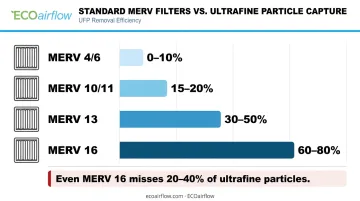
According to measured research by Stephens and Siegel on residential HVAC filters in the 7–100 nanometer range:
| Filter Rating | UFP Removal (approx.) |
|---|---|
| MERV 4/6 | 0–10% |
| MERV 10/11 | 15–20% |
| MERV 13 | 30–50% |
| MERV 16 | 60–80% |
These are measured study results — not official MERV ratings. Even MERV 16, the highest standard residential rating, misses 20–40% of the ultrafine particles that pose the greatest health risk.
Passive pleated filters work by physical collision: particles large enough to hit a fiber get trapped; particles smaller than the gaps pass through. No passive filter can close those gaps enough to catch UFPs while still allowing adequate airflow.
How Electronic Polarization Technology Works Differently
ECOairflow's patented Electronic Polarization Technology (EPT) replaces collision with electromagnetic attraction. Instead of blocking particles, it charges them.
The system generates an electronic corona field within the filter housing. Airborne particles passing through this field acquire a charge and are drawn to the glass-fiber collector pad — pulled toward the fibers rather than randomly colliding with them.
Every fiber across the full depth of the pad acts as an attracting surface, regardless of particle size.
A secondary mechanism called agglomeration further improves performance: charged particles also attract each other, clumping into larger clusters that are captured even more readily on subsequent passes.
The practical results from independent lab testing (Intertek ETL-certified protocol):
- ECOairflow's Model 2300 captured 74.73% of PM0.1 ultrafine particles vs. HEPA's 49.19% — approximately 50% more effective
- The Model 1000 captures particles down to 0.001 microns; the Model 1500 to 0.007 microns
- A 12-week hospital study documented a 54% reduction in fan power consumption compared to a standard MERV 8 + MERV 14 bag filter configuration
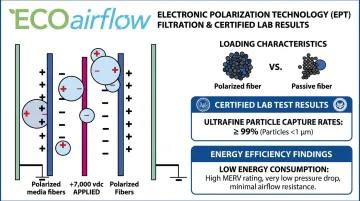
Because EPT uses electromagnetic attraction rather than dense mechanical weaving, the filter media stays open and low-resistance. Pressure drop holds as low as 0.11 in.w.c., compared to 0.6–1.2 in.w.c. for traditional hospital filter configurations — better ultrafine particle capture without the added energy cost.
Common Myths About Aerosol Particles and Air Quality
Myth 1: If I Can't See It, It Can't Hurt Me
The most dangerous particles — PM2.5 and UFPs — are completely invisible to the naked eye. A room can look spotless and still contain hundreds of thousands of ultrafine particles per cubic centimeter. Visibility tells you nothing about air quality at the particle sizes that matter for health.
Myth 2: Air Pollution Is Only a Problem Outdoors
EPA research found that levels of several organic pollutants average 2–5 times higher indoors than outdoors. Common indoor sources include:
- Cooking (especially on gas stoves)
- Burning candles and fireplaces
- Smoking products
- Cleaning sprays and household chemicals
- Off-gassing from furniture and building materials
Outdoor particles also infiltrate indoors through ventilation gaps and HVAC systems, bringing vehicle exhaust, wildfire smoke, and road dust with them.
Myth 3: Any Air Filter Will Clean My Air Effectively
Given how much pollution originates indoors, filter selection matters more than most people realize. Filter quality varies enormously, and even high-MERV passive filters have a fundamental limitation against UFPs. A MERV 13 pleated filter captures 30–50% of ultrafine particles in measured testing. A MERV 16 captures 60–80%. Neither comes close to addressing the full UFP threat.
ECOairflow's electronic air cleaners take a different approach. The Model 1000 (MERV 11) captures particles down to 0.001 microns using patented Electronic Polarization Technology — far smaller than any passive pleated filter reaches. The Dynamo 1" is independently documented as twice as effective as HEPA at ultrafine particle capture. For particles most linked to cardiovascular and neurological harm, that gap in performance is what separates adequate filtration from genuinely protective filtration.
Frequently Asked Questions
What is the difference between an aerosol and a particle?
An aerosol is the complete system — particles suspended in a gas, like air. A particle is the individual solid or liquid matter itself. You breathe aerosols; what deposits in your lungs are particles.
What are PM2.5 and PM10?
PM10 refers to inhalable coarse particles under 10 microns — dust, pollen, mold spores. PM2.5 refers to fine particles under 2.5 microns, primarily from combustion. PM2.5 penetrates deeper and poses significantly greater health risk.
Are smaller aerosol particles more dangerous?
Yes. Ultrafine particles (PM0.1, under 0.1 microns) are the most dangerous because they bypass all the body's natural respiratory defenses, enter the bloodstream directly, and can reach vital organs including the heart and brain.
What are the main sources of dangerous indoor aerosol particles?
Common sources include gas stove cooking, burning candles, smoking, and printer toner and cleaning product fumes. Outdoor particles from vehicle exhaust and wildfire smoke also enter through HVAC systems and ventilation gaps.
Do all air filters capture ultrafine particles?
No. Standard pleated filters are largely ineffective below 0.3 microns, which is where UFPs live. Capturing particles in the PM0.1 range requires specialized active technology, such as ECOairflow's Electronic Polarization Technology (EPT).
What does the MERV rating on a filter tell me about particle size?
MERV measures capture efficiency for particles between 0.3 and 10 microns. It says nothing about performance against ultrafine particles smaller than 0.3 microns — which are the particles most associated with serious cardiovascular and neurological health effects.