The confusion is understandable. Choosing the wrong filter — or assuming any filter alone solves the problem — leaves real risk on the table.
This article breaks down exactly how each filter type works, what the real COVID protection difference is, and which makes sense for your home, office, school, or healthcare facility.
Key Takeaways
- HEPA filters (MERV 17+ equivalent) capture 99.97% of particles at 0.3 microns — hospital-grade performance, but they're incompatible with standard residential HVAC ductwork
- MERV 13 is the EPA-recommended minimum for COVID mitigation in HVAC systems, capturing 50–85% of particles in the 0.3–1.0 micron range
- SARS-CoV-2 travels on aerosol carrier particles (1–4 microns) — both filter types target these carriers, not the 0.07-micron virus directly
- No single filter eliminates COVID risk on its own; layered strategies combining filtration, ventilation, and adequate air changes deliver the strongest protection
HEPA vs MERV 13: Quick Comparison
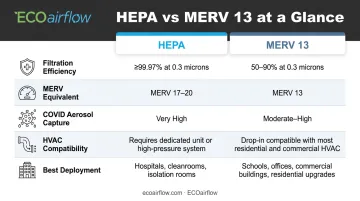
Both HEPA and MERV 13 filters reduce airborne COVID carriers, but they serve different applications and come with real trade-offs. Here's how they compare at a glance.
| Factor | HEPA | MERV 13 |
|---|---|---|
| Filtration Efficiency | 99.97% at 0.3 microns | 50–85% at 0.3–1.0 microns |
| MERV Equivalent | MERV 17–20 | MERV 13 |
| COVID-Relevant Performance | Very high aerosol capture | Meaningful capture of 1–4 micron carriers |
| HVAC Compatibility | Not compatible with standard ductwork | Compatible with most commercial systems (verify first) |
| Best Deployment | Standalone units; hospital isolation rooms | HVAC filter replacement in most buildings |
| Filter Lifespan | 1–2 years (standalone units) | Follow manufacturer recommendations |
For facilities that need HVAC-integrated filtration beyond MERV 13 — without HEPA's pressure drop or ductwork constraints — ECOairflow's M-Series Hybrid achieves MERV 13–16 (powered and unpowered) and has independently tested at 74.73% PM0.1 capture, compared to 49.19% for HEPA in that particle size range.
What Is a HEPA Filter?
HEPA — High Efficiency Particulate Air — is a performance standard, not a brand or material. According to the EPA, any filter that removes at least 99.97% of airborne particles at 0.3 microns qualifies. That places it at MERV 17–20 equivalent on the standard rating scale.
Why 0.3 Microns Is the Benchmark
The 0.3-micron threshold isn't arbitrary. It represents the Most Penetrating Particle Size (MPPS) — the hardest size for any filter to catch. Because HEPA ratings are based on worst-case performance, actual capture of both smaller and larger particles is even higher. A filter that clears 99.97% at its hardest point is effectively stopping everything else at an even higher rate.
How HEPA Filters Actually Work
HEPA media is a dense, randomly arranged mat of glass fibers. It captures particles through three physical mechanisms:
- Impaction — larger particles can't follow airstream curves and collide with fibers
- Interception — mid-size particles graze fibers while following the airflow and stick
- Diffusion — ultra-fine particles move erratically and contact fibers by Brownian motion
Multiple physical forces work simultaneously, which is why HEPA outperforms simple mechanical filtration across a wide particle size range.
The Core HVAC Limitation
HEPA media creates high static pressure drop. Most standard HVAC fans cannot push adequate airflow through HEPA-grade media without straining equipment, reducing airflow volume, or increasing energy costs significantly. The EPA is direct on this: true HEPA filters are normally not installed in residential HVAC systems and would require professional modification to work inline.
Where HEPA is appropriate:
- Hospital isolation wards and Protective Environment Rooms (where CDC mandates 99.97% HEPA filtration for recirculated air)
- Pharmaceutical cleanrooms and sterile manufacturing environments
- Standalone portable air purifiers used as room-level supplements
A 2021 hospital study published in Infection Control & Hospital Epidemiology found that two portable H13 HEPA air cleaners reduced aerosol clearance time in a COVID patient room from 16 minutes to 5.5 minutes — demonstrating measurable real-world impact in controlled clinical settings. demonstrating measurable real-world impact in controlled clinical settings. That performance baseline raises a practical question: how does MERV 13 — the standard most HVAC systems can actually accommodate — compare when it comes to COVID protection?
What Is a MERV 13 Filter?
MERV — Minimum Efficiency Reporting Value — is a standardized rating system developed by ASHRAE under Standard 52.2. It measures a filter's ability to capture particles across three size ranges: 0.3–1.0 microns, 1.0–3.0 microns, and 3.0–10.0 microns.
MERV 13 Performance Thresholds
Per the EPA's MERV table, MERV 13 must achieve:
- ≥50% efficiency for particles in the 0.3–1.0 micron range
- ≥85% efficiency for particles in the 1.0–3.0 micron range
- ≥90% efficiency for particles in the 3.0–10.0 micron range
Many home HVAC systems default to MERV 8. Upgrading to MERV 13 is a significant step, especially in the 1–3 micron range where MERV 8 captures almost nothing.
Why MERV 13 Is the COVID Threshold
SARS-CoV-2 virions are roughly 0.07–0.09 microns — far too small for MERV 13 to capture directly. But the virus doesn't float alone. Research published in Scientific Reports found airborne SARS-CoV-2 RNA most concentrated in particles with 0.5–4 micron aerodynamic diameter. A separate 2023 study found 90% of exhaled SARS-CoV-2 RNA in aerosol particles below 4.5 microns. MERV 13 captures these carrier aerosols at 85–90%+ efficiency, which is why health agencies point to it as the minimum meaningful standard for COVID risk reduction.
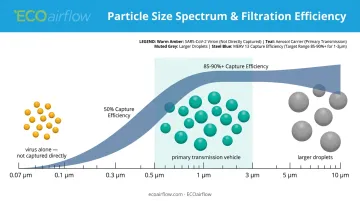
The EPA and CDC both recommend MERV 13 (or the highest rating a system can handle) as the minimum standard for COVID risk reduction in buildings.
Airflow and Compatibility Considerations
Higher MERV ratings increase filter resistance. Before upgrading, verify your HVAC system can handle the added pressure drop — consult the system manual or an HVAC professional. Systems that can't handle standard MERV 13 media may benefit from electronically enhanced filtration instead.
ECOairflow's M-Series Hybrid achieves MERV 13–16 certification under ASHRAE 52.2 while maintaining a pressure drop of just 0.13–0.37 in. w.g. — far below the 0.6–1.2 in. w.g. typical of conventional high-efficiency filter configurations. That lower resistance makes it viable in systems where a standard passive MERV 13 pleated filter would create airflow problems.
Where MERV 13 fits best:
- Commercial office buildings, schools, and retail spaces
- Residential properties with modern HVAC systems
- Any building where in-duct filter replacement is the preferred approach
A 2022 study on passenger railcars found that upgrading from MERV 8 to MERV 13 increased particle removal rates by 3.8–8.4 per hour for 0.3–10 micron particles and reduced modeled SARS-CoV-2 infection probability by 42% compared to MERV 8.
HEPA vs MERV 13 for COVID Protection: Which Wins?
Neither filter directly captures free-floating viral particles at 0.07 microns. Both work by capturing the larger aerosol droplets (1–5 microns) that carry the virus. The deciding factors are filtration efficiency at relevant particle sizes — and whether the filter can actually run in your building.
The Filtration Performance Gap
- HEPA: 99.97% at 0.3 microns
- MERV 13: ~50% at 0.3 microns, ~85% at 1–3 microns
In clinical environments — hospitals, care homes, immune-compromised patient areas — this gap matters enormously. In lower-density commercial or residential settings with multiple air changes per hour, MERV 13 delivers meaningful risk reduction at a fraction of the implementation complexity.
Layered Protection Outperforms Filter Choice Alone
Deployment reality shapes this decision significantly. HEPA cannot run inline in standard HVAC ductwork without significant modifications and airflow consequences, which is why most buildings default to MERV 13 as a direct drop-in upgrade. That installation constraint is also why layering matters more than filter choice alone.
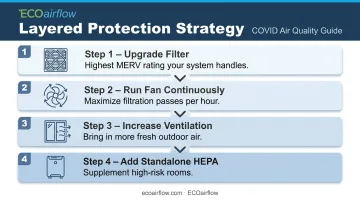
The EPA is explicit: upgraded filtration alone is not enough to protect against COVID-19 — and filters only clean air when air moves through them. Running the HVAC fan continuously (not only during heating or cooling cycles) dramatically increases filtration passes per hour. The CDC recommends targeting at least 5 air changes per hour of clean air in occupied spaces.
- Upgrade to the highest MERV rating your system can handle
- Run the HVAC fan continuously, not just on-demand
- Increase outdoor air ventilation where possible
- Supplement with standalone HEPA units in high-risk rooms
Situational Recommendation
| Setting | Recommendation |
|---|---|
| Healthcare facility, isolation room | HEPA (standalone or integrated); MERV 14A–16A pre-filter stage |
| Hospital general areas, ORs | ASHRAE 170-compliant filtration (MERV 14A/16A) + HEPA terminal |
| Commercial offices, schools | MERV 13 minimum via HVAC upgrade; electronically enhanced options where pressure drop is a constraint |
| Residential (standard) | MERV 13 HVAC upgrade + continuous fan operation |
| Residential (vulnerable occupants) | MERV 13 HVAC upgrade + portable HEPA unit in primary living areas |
For commercial and hospital settings where pressure drop is a limiting factor, electronically polarized EAC filters — such as ECOairflow's M-Series Hybrid, which is Appendix J certified and ASHRAE 170 compliant — can achieve MERV 13–16A performance with significantly lower static pressure than passive pleated alternatives.
Real-World Application: Matching Filter Choice to Your Setting
Residential
Most home HVAC systems can accommodate a MERV 13 upgrade, but confirm compatibility before purchasing. Running the fan continuously can triple or quadruple filtration cycles per hour in an average home. For households with vulnerable members, a portable HEPA unit in the living room or bedroom adds meaningful supplemental protection without requiring any HVAC modification.
Commercial Buildings, Offices, and Schools
MERV 13 is the appropriate minimum, achievable through direct filter replacement in most commercial air handlers.
Facilities with older or lower-capacity systems that can't handle passive MERV 13 pressure drop should evaluate electronically enhanced filtration options. ECOairflow's EPT-based M-Series Hybrid delivers MERV 13–16 certified performance with a pressure drop of just 0.13–0.37 in.w.c. That's roughly three to nine times lower than conventional high-efficiency filter configurations, making it compatible with systems that would struggle with dense passive media.
Hospitals and High-Occupancy Critical Environments
CDC guidance requires HEPA filtration for air recirculated from airborne infection isolation rooms and Protective Environment Rooms. In practice, this typically means a HEPA terminal unit as the final filter stage. ECOairflow's M-Series is designed to replace the energy-intensive MERV 8 pre-filter + MERV 14 bag filter stage that sits upstream of HEPA. It maintains full ASHRAE 170 compliance while reducing fan power consumption by a documented 54% over 12 weeks in independent testing.
Frequently Asked Questions
Is MERV 13 considered HEPA?
No. HEPA filters are equivalent to MERV 17 or higher and must capture 99.97% of particles at 0.3 microns. MERV 13 achieves 50–85% efficiency in that range — a significant gap that matters most in clinical and high-risk settings.
What MERV rating filters COVID?
The EPA recommends a minimum of MERV 13 for COVID mitigation, as it captures the 1–4 micron aerosol droplets that carry the virus at 85–90%+ efficiency. Higher ratings (MERV 14–16) offer incrementally better performance where systems can handle the added resistance.
Will MERV 13 restrict airflow?
It can. MERV 13 creates more resistance than lower-rated filters, and whether your system handles it depends on the HVAC fan's capacity. Consult your system manual or an HVAC professional before upgrading — or consider electronically enhanced options with lower pressure drop profiles.
Can MERV 13 filters capture the COVID-19 virus directly?
Not directly. The SARS-CoV-2 virus itself (0.07–0.09 microns) is smaller than MERV 13's rated capture range. However, the virus travels on larger aerosol carrier particles (1–4 microns) that MERV 13 captures at 85%+ efficiency — making it effective at reducing transmission risk.
Is a HEPA filter worth it for a home?
Yes, for households with immunocompromised members or high exposure risk. For most homes, upgrading to MERV 13 and running the HVAC fan continuously is a practical, lower-cost first step — and it covers the whole house rather than a single room.
How often should MERV 13 and HEPA filters be replaced?
Replacement intervals vary by product, airflow, and air quality — always check manufacturer guidelines. Residential filters typically run 3-month cycles; commercial applications often stretch to 3–6 months depending on facility load. Monitoring pressure drop or visible pad condition works as a practical check for any filter type.