The catch? Many project teams underestimate the complexity involved. Choosing the wrong compliance path, missing a pre-condition, or allowing finish work too close to testing are all common reasons projects fail and face costly retesting delays. This article walks through exactly what the credit requires, how to prepare, and what separates passing projects from those that need a second attempt.
Key Takeaways
- The IAQ Assessment credit sits within LEED's Environmental Quality (EQ) category and is worth 1 to 2 points depending on the path chosen
- Two paths exist under LEED v4.1: Flush-Out (1 point) and Air Testing (up to 2 points)
- LEED v5 shifts to testing and monitoring pathways only; flush-out no longer qualifies
- Testing measures PM2.5, PM10, carbon monoxide, ozone, TVOCs, and formaldehyde post-construction, pre-occupancy
- High-efficiency filtration, HVAC commissioning, and low-VOC materials drive the most successful outcomes
- Common failures trace back to late-stage painting or cleaning activity near air sample locations
What Are LEED Indoor Air Quality Credits?
LEED's Environmental Quality (EQ) category covers thermal comfort, air quality, acoustics, and lighting — the conditions that most directly affect occupant health and productivity. According to the LEED v4.1 BD+C Guide, the EQ category totals 15–16 points depending on the project adaptation. The IAQ Assessment credit alone accounts for up to 2 of those points, representing roughly 12.5–13.3% of the entire EQ category.
When grouped with Enhanced IAQ Strategies, Low-Emitting Materials, and Construction IAQ Management, air quality-focused credits account for approximately 8 of the 15–16 EQ points — more than half the category.
BD+C, ID+C, and O+M: What's Different
The credit applies differently depending on the building's status:
- BD+C and ID+C (new construction, major renovations, interior fit-outs): Post-construction, pre-occupancy IAQ assessment — the focus of this article
- O+M (existing buildings in operation): Performance-based indoor air assessment with baseline testing and ongoing monitoring for buildings that have been occupied for an extended period
What LEED v5 Changes
USGBC's materials on LEED v5 describe a shift toward air quality testing and continuous monitoring. The v5 credit library identifies EQc5 Air Quality Testing and Monitoring — with requirements covering CO2, PM2.5, TVOC, and temperature monitoring — and flush-out does not appear as a pathway. For v5 projects, verify the specific requirements in the current reference guide, as this standard continues to evolve.
How to Earn LEED IAQ Credits Step by Step
Start by selecting your compliance path. This choice depends on your project timeline, occupancy schedule, HVAC capacity, and how many points the project needs. Under LEED v4.1, the paths cannot be combined.
Option 1 – Building Flush-Out (1 Point)
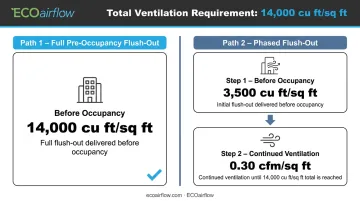
The HVAC system must supply a total of 14,000 cubic feet of outdoor air per square foot of gross floor area, while maintaining:
- Internal temperature between 60°F and 80°F
- Relative humidity at or below 60%
- New filtration media installed before flush-out begins
Two sub-paths exist:
- Path 1: Complete the full flush-out before occupancy begins
- Path 2: Deliver at least 3,500 cu ft/sq ft before occupancy, then continue ventilation at a minimum of 0.30 cfm per square foot until the 14,000 cu ft/sq ft total is reached
Document flow rates, start and end times, and confirm that dampers and system settings are reset at completion.
Option 2 – Air Quality Testing (1–2 Points)
Path 1 (1 point): Test for PM2.5, PM10, carbon monoxide, and ozone using EPA-, ASTM-, or ISO-approved methods. Use calibrated direct-reading instruments measured in real time and compare results against LEED's allowable concentration thresholds. No lab submission is required — results are recorded on-site and submitted directly to GBCI.
Path 2 (1 additional point): Conduct a TVOC screening using ISO 16000-6, EPA TO-17, or EPA TO-15. Per LEED v4.1 credit requirements, if TVOC levels exceed 500 µg/m³, investigate individual VOC sources, correct them, and retest.
Also test for individual VOCs listed in LEED Table 2 — including formaldehyde and benzene — using an ISO/IEC 17025-accredited laboratory.
Universal Testing Conditions
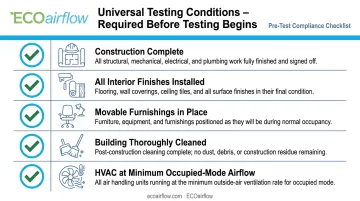
Regardless of path, these conditions must be met before testing begins:
- All construction is complete
- All interior finishes are fully installed (millwork, doors, paint, carpet, acoustic tiles)
- Movable furnishings are in place
- The building has been thoroughly cleaned
- The HVAC system is operating at the minimum outdoor airflow rate for occupied mode
Submit documentation with exact concentration values to GBCI for review.
What Your Building Needs Before Pursuing the IAQ Credit
Preparation determines whether you pass on the first attempt. Teams that treat IAQ requirements as a final-phase checklist item consistently run into problems.
HVAC System Readiness
The HVAC system must be fully commissioned and operational before either compliance path begins. Mechanical engineers should verify:
- Air handling units can deliver required outdoor air volumes
- Damper positions are correctly set
- The system can maintain required temperature and humidity conditions throughout the flush-out or testing period
With the system confirmed operational, filtration media becomes the next critical variable to address.
Filtration Media
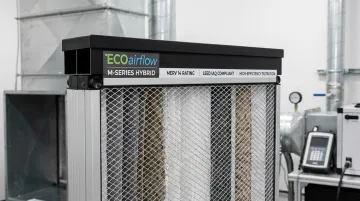
New filtration media must be installed before flush-out begins — this is a formal LEED requirement. For projects pursuing the air testing path, high-efficiency filters rated MERV 13 or higher are strongly recommended, as they directly reduce the particulate matter concentrations measured during testing.
ECOairflow's M-Series Hybrid filters are certified at MERV 13–16 under ASHRAE 52.2, including the Appendix J conditioning protocol, which tests real-world field performance rather than idealized lab conditions. The filters carry ETL listing (Intertek) and are verified to UL 2998 Zero Ozone standards (below 0.0005 ppm) — directly relevant to LEED ozone concentration thresholds.
Independent testing documents 74.73% capture of PM0.1 ultra-fine particles, which are far smaller than the PM2.5 threshold LEED measures. LEED EQ credit submittal documentation is available on request for specifying engineers by contacting ECOairflow at 1-877-347-3569.
Interior Finishes and Low-VOC Materials
All interior finishes must be fully installed before testing begins. Materials continue to off-gas VOCs during and after installation — testing before finishes are complete will not reflect actual occupancy conditions, which invalidates the results.
Low-VOC paint, adhesives, sealants, and furnishings reduce the risk of VOC testing failures under the air testing path. Select compliant materials during the design phase and track them throughout construction to avoid surprises at testing time. Per the EPA, indoor VOC concentrations are consistently higher than outdoors — often up to 10 times higher — making material selection one of the highest-leverage variables in the entire process.
Key Factors That Determine Whether You Pass IAQ Testing
Even well-prepared projects can fail if critical variables aren't controlled during the testing window.
Air Filtration Efficiency
The MERV rating of installed filters is a primary variable affecting particulate matter results. Filters that cannot effectively capture PM2.5 and PM10 will leave measurable concentrations in the air during testing. Filters certified under ASHRAE 52.2 Appendix J — tested powered, unpowered, and under real-world airflow conditions — provide documented, real-use performance data rather than controlled-lab figures.
HVAC Ventilation Rate
The HVAC system must run at the minimum outdoor airflow rate for occupied mode throughout the entire test period. A common misunderstanding is that running systems at maximum airflow produces better results. It doesn't — testing under occupied-mode minimums is what LEED requires, and deviation invalidates the sample.
VOC Off-Gassing Timeline
The elapsed time between material installation and testing significantly affects TVOC concentrations. Research published in PMC (Kozicki et al., 2021) found that product type strongly drives emissions — solvent-based flooring adhesives emit substantially more TVOCs than water-based alternatives.
New paint, sealants, and furnishings continue off-gassing for days or weeks after installation. LEED does not specify a minimum buffer period, but industry practice consistently favors as much decay time as the schedule allows before tests are scheduled.
Outdoor Air Quality
Regional ambient conditions affect baseline pollutant levels entering through the ventilation system. Teams in areas with elevated PM or ozone should take these steps before scheduling tests:
- Check regional air quality data at AirNow
- Identify days with favorable AQI readings in your pollutant categories
- Factor background PM or ozone levels into your expected baseline readings
Common Mistakes That Cause LEED IAQ Testing to Fail
These are the errors that show up repeatedly across failed tests — most are avoidable with proper scheduling.
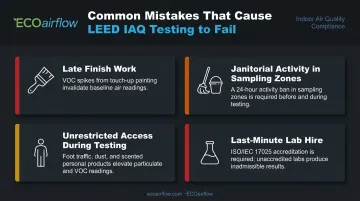
Schedule a firm cutoff for all finish work well before the test date. Painting, caulking, and adhesives introduce VOC spikes that persist for days — touch-up painting is one of the most frequently cited failure causes.
Ban all janitorial activity from sampling zones at least 24 hours before testing. Cleaning products contain VOCs, floor buffing stirs particulate matter, and moving a supply cart through a sampling area can elevate PM counts enough to fail the test.
Restrict access to essential personnel only during active testing. Human movement redistributes settled dust, and scented products — perfume, cologne, hand sanitizer, hair spray — raise particulate readings in sampling zones.
Engage your testing consultant early enough to verify laboratory credentials before sampling begins. Labs analyzing VOC samples must be ISO/IEC 17025 accredited for the specific methods used — non-accredited results cannot be submitted to GBCI. Last-minute hires frequently surface incorrect test methods or missed pollutants after it's too late to correct them.
Frequently Asked Questions
What is LEED indoor air quality testing?
LEED IAQ testing is a performance verification process conducted after construction and before occupancy. A qualified consultant measures specific indoor pollutants: particulate matter, carbon monoxide, ozone, VOCs, and formaldehyde — against LEED-defined concentration limits to confirm the building is safe for occupants before they move in.
What is the LEED indoor air quality credit?
Formally titled "EQ Credit: Indoor Air Quality Assessment" under LEED v4.1, this credit sits within the Environmental Quality category. Project teams earn 1 to 2 LEED points by demonstrating acceptable indoor air quality through a flush-out or air quality testing process before occupancy.
What is LEED indoor environmental quality?
The Indoor Environmental Quality (EQ) category is one of LEED's core scoring categories, covering conditions that affect occupant health and comfort: air quality, ventilation, thermal comfort, lighting, and acoustics. At up to 2 of the 15–16 available EQ points, the IAQ Assessment credit ranks among the highest-value individual credits in the category.
How many LEED points can you earn for indoor air quality?
The IAQ Assessment credit earns 1 point via the flush-out path or up to 2 points via air testing (1 point for particulates and inorganic gases, 1 additional point for VOCs). The broader EQ category offers many additional credits across ventilation, materials, and comfort strategies.
What pollutants are tested in LEED IAQ air testing?
Path 1 tests PM2.5, PM10, carbon monoxide, and ozone. Path 2 tests total VOCs, formaldehyde, and other individually listed VOCs such as benzene. Thresholds vary by registered LEED version.
Does LEED v5 still allow the building flush-out option?
Based on USGBC's published v5 credit materials, the air quality testing and monitoring pathway (EQc5) is the framework presented for v5 projects; flush-out does not appear as a listed option. Projects registered under v5 should confirm exact requirements in the current LEED v5 reference guide before selecting a compliance approach.