Introduction
Most homeowners assume their HVAC filter is doing the heavy lifting for indoor air quality. It's running constantly, it's built into the system, so it must be cleaning the air — right?
Not quite. According to the EPA, indoor air can be 2–5 times more polluted than outdoor air, and in some cases more than 100 times higher. The filter in your HVAC system was designed to protect your equipment — not your lungs. That distinction matters more than most people realize.
What each solution actually does — and where each one falls short — depends heavily on your situation. Whether you're a homeowner managing allergies or a facility manager overseeing a commercial building, the right answer isn't the same for everyone.
Key Takeaways
- HVAC filters protect equipment first; actual air quality improvement depends entirely on the MERV rating
- Standard residential filters (MERV 4–8) miss fine allergens, bacteria, and virtually all VOCs
- True HEPA purifiers capture 99.97% of particles at 0.3 microns but only clean one room at a time
- Electronic HVAC filters using polarization technology can reach MERV 13–16 performance without the airflow restriction that strains equipment
- The right choice comes down to scope — whole-home coverage, room-level precision, or a combination of both
Air Purifier vs. HVAC Filter: Quick Comparison
Here's how the two most common options stack up across the factors that matter most to homeowners and facility managers.
| Factor | HVAC Filter | Standalone Air Purifier |
|---|---|---|
| Coverage | Whole home via ductwork | Single room or zone |
| Operation | Only when HVAC runs | Continuous, independent |
| Fine Particle Capture | Depends on MERV rating | True HEPA: 99.97% at 0.3 microns |
| VOC/Odor Removal | No (particle filter only) | Yes, with activated carbon layer |
| Energy Impact | High-MERV filters can strain HVAC fan | Low wattage; no HVAC interaction |
| Maintenance | Replace every 1–3 months | Filter replacement every 6–12 months |
| Best For | Whole-home baseline protection | Targeted room-level concerns |
Note: HVAC-integrated electronic air cleaners (EACs) represent a third category worth considering — they deliver whole-home coverage like a standard HVAC filter while capturing ultra-fine particles that passive filters and many portable purifiers miss.
What Is an HVAC Filter — and What Does It Actually Do?
The Real Purpose of an HVAC Filter
An HVAC filter's original job is protecting your equipment. It sits in the return air duct or air handler to prevent dust, hair, and debris from entering the blower motor, evaporator coil, and heat exchanger. Keeping the system clean is the design goal — cleaner air for occupants is a secondary benefit.
This is why most homes ship with basic filters that get the job done for equipment protection but fall well short of meaningful air quality improvement.
Understanding the MERV Rating Scale
MERV (Minimum Efficiency Reporting Value) is rated 1–16 under ANSI/ASHRAE Standard 52.2, measuring particle capture efficiency across the 0.3–10 micron range. Here's what the scale actually means:
- MERV 1–4: Catches lint and large debris; minimal fine-particle protection
- MERV 5–8: Catches mold spores, dust mite debris, and pollen — common in most residential homes
- MERV 9–12: Captures finer dust and some bacteria; meaningful improvement for allergy sufferers
- MERV 13–16: Captures fine particles, bacteria, tobacco smoke, and some viruses — ASHRAE recommends MERV 13 or higher for removing virus-laden particles
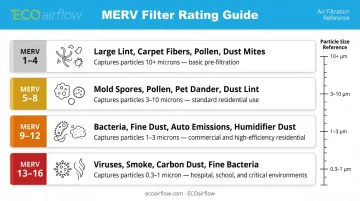
A MERV 8 filter — the residential standard — has only a 20% minimum efficiency for particles in the 1.0–3.0 micron range and no rated efficiency at all below 1 micron. Fine allergens, bacteria, and airborne viruses pass right through.
The Pressure Drop Problem
Dropping a MERV 13+ pleated filter into an HVAC system built for MERV 8 can damage your equipment. Denser filters create higher resistance to airflow (pressure drop), forcing the fan motor to work harder. Research from Lawrence Berkeley National Laboratory found that switching to MERV 16 filters decreased airflow by an average of 22% in PSC motors and caused testing to be abandoned in 20% of cases due to noise and filter displacement.
That resistance problem is exactly what electronic filtration was designed to solve.
Advanced Electronic HVAC Filters: Closing the Gap
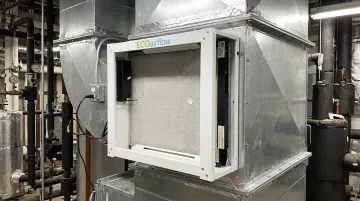
ECOairflow's Electronic Polarization Technology (EPT) uses a polarized electromagnetic field to attract particles to the filter media — like a magnet pulling metal filings — rather than relying on dense fiber weaves to physically block them. Because the media doesn't need to be dense, pressure drop stays low without sacrificing efficiency.
ECOairflow's commercial Model 2300 operates at 0.13–0.37 in.w.c., compared to 0.6–1.2 in.w.g. for traditional hospital MERV 8 pre-filter + MERV 14 bag filter configurations. Independent testing showed a 54% reduction in fan power consumption over 12 weeks versus that standard hospital configuration. All ECOairflow models carry UL 2998 Zero Ozone certification, verifying emissions below 0.0005 ppm — the strictest standard available.
What Is a Standalone Air Purifier?
How Air Purifiers Work
A standalone air purifier is a self-contained device that draws room air through multi-stage filtration — typically a pre-filter, True HEPA filter, and activated carbon layer — then recirculates cleaned air back into the space. It operates independently of your HVAC system, running continuously whether heating or cooling is active or not.
According to the EPA, a True HEPA filter captures at least 99.97% of particles at 0.3 microns — including dust, pollen, mold, and bacteria.
What Air Purifiers Capture That HVAC Filters Miss
A quality air purifier with an activated carbon layer addresses categories that even MERV 16 HVAC filters cannot touch:
- VOCs from cleaning products, paint, and furniture off-gassing
- Cooking odors and smoke
- Pet dander and fine hair particles that become airborne
- Wildfire smoke at the sub-0.3 micron range
- Chemical gaseous pollutants — formaldehyde, ammonia, and similar compounds entirely outside the MERV scale
ASHRAE is explicit that particle filters do not remove VOCs or ozone. An activated carbon layer is the only effective in-filter approach for gaseous pollutants. HVAC-integrated filtration addresses particulates at the system level but similarly cannot substitute for activated carbon when gases are the concern.
Coverage Limitations
Air purifiers are sized by Clean Air Delivery Rate (CADR) for a specific room area. The American College of Allergy, Asthma & Immunology (ACAAI) recommends CADR equal to at least two-thirds of the room's square footage for standard use.
A purifier in the bedroom does nothing for the kitchen. Whole-home coverage requires multiple units — and meaningful ongoing filter replacement costs.
Some purifier technologies carry an ozone risk worth knowing. Ionizers and ozone generators can produce harmful byproducts — the EPA warns no federal agency has approved ozone generators for occupied spaces. Passive filtration (HEPA + carbon) is the safest, most widely recommended approach. Look for UL 2998 Zero Ozone certification when evaluating any purifier.
Which Do You Actually Need?
The decision comes down to three factors: the scope of your concern (whole-home vs. room-specific), the health needs of your occupants, and your current HVAC filter's capability.
Choose an Upgraded HVAC Filter If:
- You want whole-home protection without adding new hardware
- Your primary concerns are dust, allergens, bacteria, or airborne particles
- You have central HVAC and want the most cost-effective path to broad IAQ improvement
Electronic air cleaners are the most practical upgrade for this scenario. ECOairflow's Dynamo 1" (MERV 12, 0.11 in.w.c. pressure drop) and Model 1500 (MERV 12, capturing particles down to 0.007 microns) both drop into existing 1" filter slots — no ductwork modification needed. The low-pressure-drop design can reduce annual heating and cooling costs by up to 15% compared to high-MERV pleated alternatives.
Choose a Standalone Air Purifier If:
- You live in a space without central HVAC (window units, mini-splits, apartments)
- You need to address VOCs, persistent cooking odors, or chemical off-gassing in a specific room
- You can't modify your building's HVAC system
Choose Both If:
- Household members have diagnosed asthma, allergies, or compromised immune function
- You're in a wildfire-prone region or high-pollution urban area
- You manage a healthcare, hospitality, or commercial facility with elevated IAQ standards
In the "both" scenario, the two systems divide the work. CDC/NIOSH research shows HEPA-grade filtration outperforms MERV 16 at capturing human-generated infectious particles — but HEPA's high pressure drop makes it impractical in central systems. Powered in-room HEPA units handle that role instead, while a high-efficiency HVAC filter maintains whole-building baseline filtration.
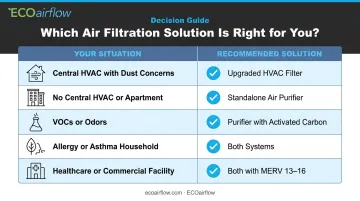
Quick Decision Guide
| Your Situation | Best Choice |
|---|---|
| Central HVAC, dust/allergen concerns | Upgraded HVAC filter (MERV 13–16 or advanced electronic) |
| No central HVAC or apartment | Standalone air purifier |
| VOCs, odors, or cooking smoke | Air purifier with activated carbon |
| Allergy/asthma household | Both |
| Healthcare or commercial facility | Both, with MERV 13–16 at the HVAC level |
Conclusion
Neither solution is universally better. An HVAC filter is your whole-home foundation; a standalone air purifier is your targeted layer of defense for specific rooms or specific pollutant categories. The real gap for most households is that the HVAC filter already in place is performing well below what their health situation actually requires.
For most homes, the single most effective upgrade is switching to an electronic HVAC filter that reaches MERV 13–16 performance without the pressure drop that strains equipment and drives up energy costs. ECOairflow's electronic air cleaners do exactly that — using patented Electronic Polarization Technology to capture ultra-fine particles while keeping fan power consumption low. For households with specific health needs, or rooms with localized concerns, pairing that whole-home foundation with a room-level purifier (HEPA plus activated carbon) covers the remaining gaps.
A practical way to think about it:
- Start with your HVAC filter — upgrade to an electronic filter at MERV 13+ if you haven't already
- Add a room purifier for bedrooms, home offices, or spaces with occupants who have respiratory conditions
- Skip the room purifier if your HVAC filter is already performing at the level your household needs
Frequently Asked Questions
Do air purifiers help with cat hair?
Air purifiers with True HEPA filters effectively capture airborne pet dander and fine hair particles (dander is what triggers allergic reactions, not the visible hair itself). A purifier won't collect hair from furniture or floors, but it does reduce what stays suspended in the air you breathe.
Do air purifiers help with the flu?
True HEPA purifiers can capture airborne virus-sized particles, reducing pathogen concentration in a room. A 2023 school study found portable HEPA air cleaners reduced respiratory-infection absences by roughly 27% compared to classrooms without them. They work best as a complementary layer alongside ventilation, not a standalone prevention tool.
What MERV rating do I actually need for my home?
Most residential systems run MERV 7–8, which misses fine allergens and bacteria. MERV 11–13 is a meaningful upgrade for allergy sufferers; MERV 13–16 delivers healthcare-level filtration. The catch is pressure drop — higher-MERV passive filters can strain your HVAC blower. Electronic air cleaners that achieve MERV 13–16 at low pressure drop avoid this problem entirely.
Can I put a HEPA filter in my HVAC system?
True HEPA filters are too dense for most residential HVAC systems — they restrict airflow, damage blower motors, and reduce system efficiency. Advanced electronic HVAC filters that achieve HEPA-comparable or better results at low pressure drop are the appropriate in-duct alternative.
How is an advanced electronic HVAC filter different from a standard pleated filter?
Pleated filters rely on fiber density to physically block particles, which increases pressure drop as they load. Advanced electronic filters like ECOairflow's EPT-based models use an electromagnetic charge to attract particles to the media — delivering higher filtration efficiency without the airflow restriction that strains HVAC equipment over time.
Do I need both an air purifier and an HVAC filter?
Not always. A high-efficiency HVAC filter provides whole-home baseline protection, while a standalone purifier adds targeted room-level filtration. Households with allergy, asthma, or immune-compromised occupants — or anyone dealing with VOCs and persistent odors — benefit most from running both.