Introduction
HEPA filtration has become the benchmark for serious air quality — but the pressure penalty it carries is real and expensive. Standard HEPA filters impose initial resistance of 1.0 in. w.g. or more, climbing to twice that at end-of-life. Every additional inch of resistance forces fans to work harder, driving up energy costs and accelerating mechanical wear system-wide.
Research on 15 commercial rooftop units found that doubling filter pressure drop reduced median airflow by 16% in systems without fan speed control — a direct hit to both air quality delivery and energy efficiency. For facility managers balancing infection control requirements with energy budgets, that tradeoff matters.
This article covers five low pressure drop alternatives that match or exceed HEPA-level filtration performance. Each section includes the performance data behind that option and a clear framework for choosing the right fit — whether you're managing a commercial office, hospital, school, or industrial facility.
Key Takeaways
- Standard HEPA filters start at ~1.0 in. w.g. resistance and double by end-of-life, directly driving fan energy costs
- Five proven alternatives deliver MERV 13–16 or near-HEPA performance at a fraction of HEPA's pressure drop
- Zero-ozone certification (UL 2998) is required by US FDA, NIOSH, CARB, and EPA for any electronic filtration in occupied spaces
- Life cycle cost — not purchase price — determines the true value of any filtration upgrade
- True HEPA certification remains mandatory in certain regulated environments — alternatives cannot substitute in those settings
What Pressure Drop Actually Costs You
Pressure drop is the resistance a filter creates against airflow, measured in inches of water gauge (in. w.g.). The relationship to energy is direct: higher resistance means the fan motor draws more electricity to deliver the same CFM.
Standard HEPA filters — 99.97% efficient at 0.3 microns — achieve their performance through dense glass microfiber media. That density is exactly what creates the resistance problem. Parker's published technical data shows:
| HEPA Configuration | Rated Flow | Initial Resistance | End-of-Life Resistance |
|---|---|---|---|
| Standard capacity, 99.97% | 1,000 CFM / 250 FPM | 1.00 in. w.g. | ~2.00 in. w.g. |
| High capacity, 99.97% | 2,000 CFM | 1.35 in. w.g. | ~2.70 in. w.g. |
A conventional hospital-grade filter train (MERV 8 pre-filter plus MERV 14 bag filter) runs 0.6–1.2 in. w.g. The pressure accumulates before the HEPA final filter even enters the picture.
That cumulative resistance is now a code issue, not just an operational one. ASHRAE 90.1-2022 requires fan system input power calculations to use midlife filter pressure drop (the mean of clean and final design drop), which means engineers can no longer treat filter resistance as a footnote during system design.
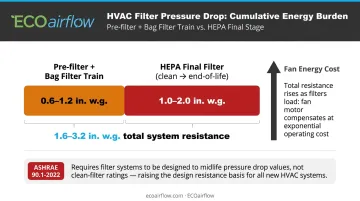
The alternatives covered below cut that resistance by up to 75% while meeting filtration performance requirements for most commercial and healthcare applications.
Top Low Pressure Drop HEPA Filter Alternatives
Each option below is evaluated on five criteria: filtration efficiency, pressure drop at rated airflow, certifications, maintenance demands, and total cost of ownership suitability.
ECOairflow Electronic Polarization Technology (EPT) Filters
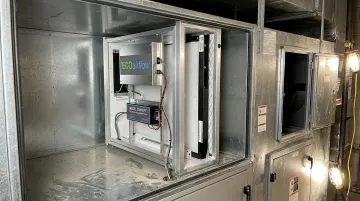
ECOairflow, headquartered in Oshawa, Ontario, manufactures powered electronic air cleaners for residential, commercial, healthcare, and industrial HVAC applications across North America. Their EPT filters use a patented electronic polarization field to actively charge and capture particles, which is what enables MERV 13–16 performance at significantly lower resistance than passive mechanical media.
The commercial Model 2300 (Dynamo 2" E.A.C.) operates at 0.13 in. w.c. at 300 FPM and 0.27 in. w.c. at 500 FPM — the standard commercial air handler face velocity. Compare that to the 0.6–1.2 in. w.g. of a traditional ASHRAE 170-compliant hospital filter train. An independent 12-week study comparing the Model 2300 against a MERV 8 pre-filter + MERV 14 bag filter configuration documented a 54% reduction in total fan power consumption on identical air handlers.
The M-Series Hybrid is the hospital-specific variant, certified MERV 13-A through 16-A under ASHRAE 52.2 Appendix J — meaning it maintains its full rated performance whether powered, unpowered, or under Appendix J conditioning. This is operationally critical for medical treatment rooms where filtration must hold during a power interruption.
Independent lab testing also found the Model 2300 captures 74.73% of PM0.1 ultra-fine particles versus 49.19% for HEPA — making EPT more effective than HEPA at the ultra-fine end of the particle spectrum.
| Specification | ECOairflow EPT (Model 2300) |
|---|---|
| Pressure Drop | 0.13 in. w.c. @ 300 FPM / 0.27 in. w.c. @ 500 FPM |
| Filtration Level | MERV 13–16 (ASHRAE 52.2); captures to 0.001 microns |
| Certifications | ETL Listed; UL 2998 Zero Ozone; Appendix J (M-Series); ASHRAE 170 / CSA Z317.2 (M-Series) |
| Power Draw | 2 watts per unit |
| Key Feature | Zero-ozone EPT; maintains rated MERV powered and unpowered (M-Series); permanent aluminum frame, recyclable pads |
Extended Surface Bag / Pocket Filters (MERV 13–15)
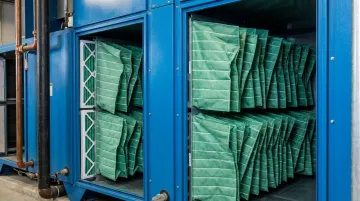
Bag filters use large pleated media pockets to dramatically expand the effective filtration area within a standard housing. More surface area means lower air velocity across the media — and lower velocity is the primary mechanism for keeping pressure drop manageable while achieving MERV 13–15 efficiency.
AAF's DriPak 2000 (24×24×36", 8 pockets, 104 sq. ft. media) at 2,000 CFM demonstrates the advantage clearly:
| Configuration | Initial Resistance | Final Resistance |
|---|---|---|
| MERV 14, 2,000 CFM / 500 FPM | 0.24 in. w.g. | 1.0 in. w.g. |
| MERV 15, 2,000 CFM / 500 FPM | 0.33 in. w.g. | 1.0 in. w.g. |
| Camfil Hi-Flo ES, MERV 15, 2,000 CFM | 0.53 in. w.g. | 1.5 in. w.g. max |
Initial resistance is a fraction of standard HEPA — but note that end-of-life resistance climbs to 1.0–1.5 in. w.g., which needs to factor into fan energy calculations over the filter's service life.
Bag filters are widely available from multiple manufacturers and compatible with most existing AHU frame sizes, making them a drop-in upgrade for facilities moving from flat panel HEPA configurations.
| Specification | Bag / Pocket Filters |
|---|---|
| Pressure Drop | 0.24–0.53 in. w.g. initial at 2,000 CFM (product-specific) |
| Filtration Level | MERV 13–15; not classified as true HEPA |
| Key Feature | High media area; drop-in AHU compatibility; widely sourced |
V-Bank / Mini-Pleat High-Efficiency Filters (MERV 14–16)
V-bank filters arrange deeply pleated media in a V or W configuration inside a rigid housing, maximizing the ratio of media area to face area. This geometry allows MERV 14–16 efficiency — approaching sub-HEPA performance — while maintaining lower initial resistance than a flat HEPA panel of the same face dimensions.
Camfil's Durafil ES3 covers MERV 13–16 configurations in commercial and industrial mini-pleat V-bank formats, with a maximum final pressure drop of 1.50 in. w.g. The rigid housing maintains pleat geometry under varying airflow conditions — a structural advantage over pocket-style bags in high-velocity applications.
Under EN 1822, EPA classes E10 (≥85%), E11 (≥95%), and E12 (≥99.5%) efficiency at the most penetrating particle size are achievable in V-bank configurations — but only when the specific unit is tested and labeled to that class. The geometry alone does not confer the classification; look for the test data.
The primary trade-off is upfront cost — V-bank filters run higher than bag alternatives. For hospitals, cleanrooms, and data centers where near-HEPA efficiency is required and filter change-out labor is expensive, that cost is often recovered through longer service life and lower fan energy consumption.
| Specification | V-Bank / Mini-Pleat |
|---|---|
| Pressure Drop | Lower initial drop than flat HEPA; final limit ~1.50 in. w.g. |
| Filtration Level | MERV 14–16; EPA-class possible with specific test label |
| Key Feature | Rigid housing; compact with large media area; suited to critical environments |
Optimized Low-Drop HEPA Box Filters
These are factory-certified true HEPA filters re-engineered to reduce resistance through expanded media area, open pleat designs, deeper cassettes, or lower-density fine fiber construction. They retain the ≥99.97% particle removal certification required for regulated applications — just with less initial resistance than a standard HEPA panel.
A Camfil healthcare case study at an 800-plus-bed, 3.5-million-square-foot hospital compared two HEPA products under the same facility conditions:
| Product | Initial Pressure Drop | Reported Energy Cost | Reported Total Ownership Cost | Service Life |
|---|---|---|---|---|
| Camfil Absolute VG | 0.55 in. w.g. | $685 | $1,370 | Min. 10 years |
| AAF AstroCel HCX | 0.82 in. w.g. | $1,130 | $1,700 | 5 years |
The pressure drop difference was modest in absolute terms — 0.27 in. w.g. — but the lifetime ownership cost differential was $330 per filter position, driven primarily by energy and replacement frequency. At scale across hundreds of air handlers, that adds up quickly.
A separate University of Louisville Hospital case replacing a three-stage filter system with low-drop HEPA filtration reported annual filtration costs dropping from $16,730 to $9,277, a documented saving of $7,259 per year, and avoided a 100 hp fan motor upgrade.
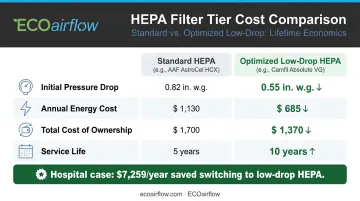
Specify this option for operating rooms, pharmaceutical cleanrooms, and BSL labs where true HEPA certification is a hard regulatory requirement. If energy costs are also a constraint, the Absolute VG-class product tier — lower initial drop, longer service life — consistently outperforms standard HEPA on total cost of ownership.
| Specification | Optimized Low-Drop HEPA |
|---|---|
| Pressure Drop | 0.55 in. w.g. initial (facility case); lower than standard HEPA |
| Filtration Level | True HEPA: ≥99.97% at 0.3 microns (IEST-RP-CC001 / EN1822 H13–H14) |
| Key Feature | Regulatory HEPA compliance maintained; longer service life than standard HEPA |
Traditional Electrostatic Precipitators (ESP)
Traditional ESPs use high-voltage ionization to charge airborne particles and collect them on oppositely charged plates. The passive media resistance is virtually zero — making them genuinely energy-efficient in terms of airflow resistance, which is why they've been used in commercial and industrial HVAC for decades.
Three limitations matter for specification decisions:
- Ozone generation: High-voltage ionization can produce ozone as a byproduct. ASHRAE guidance states that electronic air cleaners should meet UL 867 ozone limits and preferably hold UL 2998 certification before being specified for occupied spaces. Traditional ESP units often do not carry this certification — verify before specifying.
- Efficiency degradation: ESP collection efficiency declines as plates accumulate particulate. Regular cleaning is required to maintain performance, and frequency of cleaning becomes part of the maintenance budget.
- No standardized MERV equivalent: Most traditional ESP units have not been MERV-certified under ASHRAE 52.2. Efficiency claims require scrutiny.
ESP remains a viable choice in industrial settings where ozone exposure is managed and plate cleaning is built into the maintenance schedule — but for occupied commercial or healthcare spaces, require UL 2998 verification and MERV test data before specifying.
| Specification | Traditional ESP |
|---|---|
| Pressure Drop | Near-zero passive resistance; efficiency degrades without regular plate cleaning |
| Filtration Level | Varies; no standardized MERV equivalent; effective on larger particles |
| Key Feature | Lowest airflow resistance; ozone generation is a critical consideration — require UL 2998 verification |
How to Evaluate Low Pressure Drop Alternatives
The most common mistake in filter selection is comparing alternatives on purchase price or advertised efficiency without accounting for what they actually cost to run.
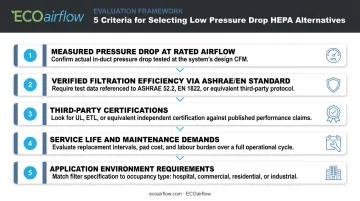
A rigorous evaluation weights five criteria:
- Measured pressure drop at rated airflow — always verify the face velocity alongside the test result; a pressure drop number without FPM is not a valid comparison
- Verified filtration efficiency — via a recognized standard: ASHRAE 52.2 MERV, IEST-RP-CC001, or EN1822; advertising a MERV rating is not the same as holding third-party certification to it
- Third-party certifications — ETL listing, UL 2998 zero-ozone verification, Appendix J certification (critical for healthcare), and LEED compatibility
- Service life and maintenance demands — filter change-out labor is a real cost; longer intervals reduce both labor and replacement media spend
- Application environment — ASHRAE 170 specifies MERV 16 for operating and Cesarean-delivery rooms, MERV 14 for critical care, and HEPA for protective environment and wound intensive care rooms; a lower-drop alternative must still clear the room-specific class requirement
Most life cycle cost models miss one variable: loading behavior. Traditional bag and pleated filters increase fan energy demand by 60% or more as they load, turning a filter that starts at 0.24 in. w.g. into a 1.0 in. w.g. drag on the system by end-of-life.
Electronic alternatives like ECOairflow's EPT filters maintain nearly constant pressure drop throughout pad life. That stability translates directly to lower fan energy costs — and a more accurate life cycle cost comparison.
Conclusion
No single alternative is the right answer across all applications. The correct choice depends on your specific regulatory environment, energy budget, maintenance capacity, and occupant health priorities.
- Regulated healthcare environments (OR, PE rooms, BSL labs): optimized low-drop HEPA box filters are the only compliant path — select on lowest initial drop and longest documented service life, not price
- Hospital treatment rooms, ERs, and invasive procedure spaces under ASHRAE 170 MERV 14/16 requirements: the M-Series Hybrid (MERV 14A/16A, Appendix J certified, UL 2998 Zero Ozone) cuts the energy penalty of a traditional pre-filter + bag filter train while staying compliant powered or unpowered
- Commercial and industrial facilities where MERV 13–15 meets the spec: bag filters are cost-effective and widely available; EPT electronic alternatives deliver lower life cycle energy costs and longer change intervals
- Any electronic filtration for occupied spaces: UL 2998 zero-ozone certification is a hard requirement
Request life cycle cost data, not just spec sheets, from any supplier before finalizing a specification. Hidden costs — elevated fan energy, accelerated motor wear, frequent change-outs — rarely appear in the purchase comparison but dominate the five-year cost picture.
ECOairflow's EPT filters are engineered specifically for facilities where pressure drop, energy costs, and air quality compliance all matter. Reach the team directly at 1-877-347-3569 or customerservice@ecoairflow.com to discuss your application.
Frequently Asked Questions
What is the pressure drop for a HEPA filter?
Standard HEPA filters typically start at 1.0–1.35 in. w.g. for new filters at rated airflow, rising to approximately 2.0–2.70 in. w.g. at end-of-life before replacement. This climbing resistance is what drives significantly higher fan energy consumption compared to lower-drop alternatives throughout a filter's service life.
Can MERV 13–15 filters replace HEPA filters in most HVAC systems?
MERV 13–15 filters work well as HEPA alternatives in most commercial and residential applications, capturing a high percentage of fine particles including allergens and many pathogens. They are not substitutes where regulatory HEPA certification is mandated — pharmaceutical manufacturing, operating rooms, and biosafety laboratories require certified true HEPA.
How much energy can switching to a low pressure drop filter save?
An independent 12-week study comparing ECOairflow's Model 2300 against an ASHRAE 170-compliant MERV 8 pre-filter + MERV 14 bag filter hospital configuration documented a 54% reduction in total fan power consumption. For residential HVAC, ECOairflow documents up to 15% reduction in annual heating and cooling costs versus conventional pleated filters.
Do electronic air filters produce ozone?
Traditional electrostatic precipitators can generate ozone as a byproduct of high-voltage ionization, but not all electronic filters carry this risk. Third-party zero-ozone certification under UL 2998, verified by ETL (Intertek), confirms ozone emissions below 0.0005 ppm — 1/10th of the UL 867 regulatory threshold. Require this certification for any electronic filtration specified for occupied buildings.
What MERV rating is equivalent to HEPA filtration?
HEPA filters are not rated on the MERV scale — the ASHRAE 52.2 scale tops out at MERV 16, which requires ≥95% efficiency across the E1, E2, and E3 particle size ranges. True HEPA performance (≥99.97% at 0.3 microns) exceeds even MERV 16. MERV 13–16 filters are commonly specified as HEPA alternatives where certified HEPA is not a regulatory requirement.
What should I look for when selecting a low pressure drop HEPA alternative for a commercial building?
Prioritize third-party certifications (ASHRAE 52.2 MERV rating, UL 2998 zero-ozone, ETL listing), confirmed pressure drop at rated face velocity — not just initial, but end-of-life drop too — compatibility with existing AHU frame sizes, and total life cycle cost including fan energy over the filter's full service life. Appendix J certification matters if the building has any healthcare or critical environment spaces.