Introduction
Filter choice affects more than air quality. The wrong call between electrostatic and pleated can raise energy bills, shorten HVAC equipment life, and — for allergy sufferers, asthma patients, or facilities with vulnerable occupants — create genuine health consequences.
According to the EPA, Americans spend approximately 90% of their time indoors, where concentrations of some pollutants can run 2–5 times higher than outdoor levels. That makes filter selection far more consequential than most homeowners and facility managers realize.
This guide breaks down how each filter type works, what the performance numbers actually mean, and which situations call for which solution.
Key Takeaways
- Passive washable electrostatic filters cap out around MERV 10; powered electronic units like ECOairflow's EPT models achieve certified MERV 11–16
- Pleated filters (MERV 8–13) work well in standard residential systems with no electrical modifications required
- High-MERV pleated filters can choke airflow in systems not built for dense media, increasing blower strain and energy costs
- Powered electronic air cleaners hold a stable, low pressure drop — cutting fan energy load without sacrificing filtration performance
- Look for UL 2998 Zero Ozone certification before installing any powered electronic filter in an occupied space
Electrostatic vs. Pleated: Quick Comparison
Use this table to compare filter types at a glance before diving into the details below.
| Factor | Passive/Washable Electrostatic | Powered Electronic (such as ECOairflow) | Pleated |
|---|---|---|---|
| MERV Rating | Typically MERV 1–10 | MERV 11–16 (certified) | MERV 8–13 (residential) |
| Upfront Cost | Moderate | Higher | Low per filter |
| Recurring Cost | Minimal (wash and reuse) | Pad replacement every 3–6 months | Full filter every 30–90 days |
| Pressure Drop | Increases as media loads | Low and stable throughout pad life | Increases significantly as filter loads |
| Maintenance | Monthly rinsing + full dry | Tool-free pad swap | Dispose and replace |
| Environmental Impact | Minimal waste | Minimal waste (recyclable pads) | Recurring disposal waste |
| Power Required | No | Yes (2 watts or less) | No |
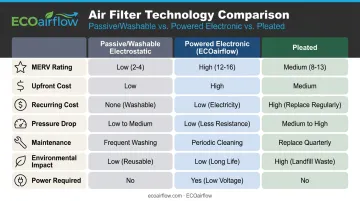
The sections below break down each factor in more detail to help you match the right filter type to your situation.
What Is an Electrostatic Filter?
Passive vs. Powered: A Critical Distinction
"Electrostatic filter" covers two fundamentally different categories, and confusing the two is the most common mistake buyers make.
Passive or washable electrostatic filters generate a static charge as air moves through layered synthetic fibers — no external power needed. They're reusable, low-cost over time, and eco-friendlier than disposables. The tradeoff: MERV ratings typically cap around 1–10, so fine allergens, smoke particles, and pathogens can slip through. As dust accumulates on the media, the static charge weakens and efficiency drops further.
Powered electronic air cleaners (EACs) work differently. An external power source — typically a 24V HVAC control circuit — creates an ionizing field that actively charges incoming particles, which are then captured on collection surfaces. Performance varies by device and should be evaluated against certified ASHRAE 52.2 test data.
What Advanced Electronic Filters Actually Capture
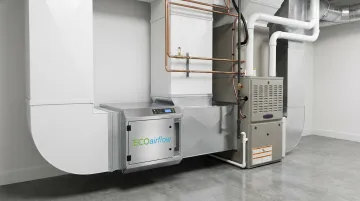
Where powered EACs separate themselves from passive filters is at the ultra-fine particle level. ECOairflow's residential and commercial EACs use patented Electronic Polarization Technology (EPT), which generates a polarized electromagnetic field that attracts particles across a wide size range — including particle sizes below what MERV ratings even measure. Their commercial Model 2300 has been independently tested to capture 74.73% of PM0.1 ultra-fine particles, compared to 49.19% for HEPA under the same conditions.
Particle types captured across the ECOairflow line include:
- Dust, pollen, pet dander, and mold spores
- Tobacco smoke, wildfire smoke, and black carbon (PM2.5/PM0.1)
- Viruses, bacteria, and airborne pathogens
- Radon daughter progeny (radioactive decay particles)
- Traffic-related air pollution and formaldehyde
The Ozone Question
One concern worth addressing: some powered EACs generate trace ozone, which matters in occupied spaces. UL 2998 Zero Ozone Verification validates that ozone remains below 0.005 ppm (the quantifiable detection limit), far below any regulatory threshold. ECOairflow's full product line — residential and commercial — carries UL 2998 certification verified by Intertek's ETL program.
Where Powered Electronic Filters Excel
ECOairflow's EACs are in active use across hospitals, airports, casinos, schools, and commercial buildings throughout North America. Three residential models are available:
- Dynamo 1" — MERV 12, lifetime electronics warranty (original owner), captures to 0.001 microns
- Model 1500 — MERV 12, captures to 0.007 microns, 5-year warranty
- Model 1000 — MERV 11, captures to 0.001 microns, 5-year warranty
All three draw 2 watts or less and connect to the standard 24V HVAC control circuit — meaning they work with virtually any US residential forced-air system.
What Is a Pleated Filter?
Pleated filters use accordion-folded polyester or cotton-blend media to physically intercept particles as air passes through. No electricity, no ionization — pure mechanical capture. They're the most widely used residential filter type, available in MERV 8–13 for home use, and they work reliably right out of the box.
Core Advantages
- Wide MERV range (8–13) to match most residential needs
- No power or wiring required
- Available in hundreds of sizes at virtually any hardware store
- Simple installation — slide in, done
A well-chosen pleated filter improves indoor air quality and protects HVAC components from debris. For households without severe IAQ concerns, a MERV 11 pleated filter offers reliable allergen capture without straining most residential blower motors.
The Pressure Drop Problem
Higher-MERV pleated filters create greater airflow resistance than lower-rated ones — that's physics. DOE testing of residential filters found that MERV 8 products had 2.7–4.7 times the pressure drop of a basic fiberglass baseline filter. At high-MERV levels (11–13), the restriction can strain blower motors in systems not rated for dense media.
The pressure drop also worsens over time. As a pleated filter loads with captured particles, airflow resistance increases — and so does fan energy consumption. This is why HVAC manufacturers specify maximum MERV ratings for their equipment; exceeding them can shorten equipment life and void warranties.
Replacement Frequency Guide
| Household Condition | Typical Replacement Interval |
|---|---|
| Standard home, no pets | Every 60–90 days |
| One pet | Every 60–90 days (inspect monthly) |
| Multiple pets | Every 30–60 days |
| Allergy sufferers | Every 30 days |
| Indoor smoking | At least every 30 days |
MERV Selection for Pleated Filters
- MERV 8 — basic dust, pollen, and larger particles; standard household protection
- MERV 11 — adds pet dander and finer allergens; Trane's recommended "sweet spot" for many homes
- MERV 13 — EPA recommends MERV 13 or the highest rating the system can accommodate; appropriate for wildfire-prone areas or moderate respiratory sensitivities
Electrostatic vs. Pleated: Which Is Better for You?
The right answer depends on four factors: filtration performance needed, your HVAC system's pressure drop tolerance, your maintenance preferences, and your budget over the long haul.
Choose Pleated If:
- Your HVAC system is compatible with MERV 8–13 media (verify the manufacturer's rating)
- You want a no-setup, no-power solution with predictable filtration
- Your air quality needs are moderate — general dust, common allergens, pet dander
- You prefer a simple disposable routine with no cleaning or maintenance learning curve
Choose Powered Electronic If:
- You need MERV 11–16 performance without the airflow restriction of dense pleated media
- You operate in a commercial, healthcare, school, or high-occupancy environment where continuous filtration matters
- You want to reduce HVAC fan energy costs over the long term
- Occupants include allergy or asthma sufferers, or you're managing wildfire smoke or pathogen risk
- You're replacing a legacy EAC (Honeywell, AprilAire, Lennox PureAir, Trane CleanEffects, or Carrier Infinity) — ECOairflow's Cabinet Conversion Kit handles drop-in retrofits without cabinet modification
The Hospital Case
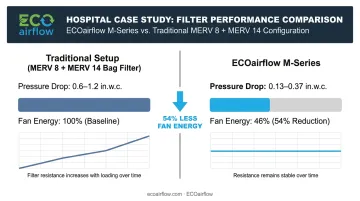
An independent 12-week study compared ECOairflow's M-Series commercial filter against the standard ASHRAE 170-compliant hospital configuration (MERV 8 pre-filter + MERV 14 bag filter). The result: a 54% reduction in total fan power consumption.
That gap comes down to pressure drop. ECOairflow's system runs at 0.13–0.37 in.w.c. versus 0.6–1.2 in.w.c. for the traditional two-bank setup — and unlike media filters, that resistance stays stable throughout the pad's service life rather than climbing as particulate loads.
ECOairflow's electronic air filtration systems span residential through hospital-grade applications, each delivering certified MERV performance, low pressure drop, and UL 2998 Zero Ozone certification. Contact ECOairflow to find the right fit for your facility or home.
Conclusion
Pleated filters are the practical, accessible choice for most standard residential HVAC systems — easy to find, simple to install, no power required, and effective across MERV 8–13. For households without severe IAQ concerns, a quality MERV 11 pleated filter is a reasonable starting point.
Electronic air cleaners are the stronger option when performance, efficiency, and long-term cost all matter — especially in commercial, healthcare, and high-occupancy environments. Key advantages over pleated media include:
- Capture ultra-fine particles that pleated filters can't reach
- Maintain stable pressure drop throughout the filter's service life
- Reduce HVAC fan energy consumption by up to 54% compared to high-MERV bag filter configurations
Before deciding, check your HVAC manufacturer's maximum rated MERV and verify filter slot dimensions. Look for certified performance data — ASHRAE 52.2 MERV ratings, Appendix J certification for in-situ environments, and UL 2998 verification for any powered filter — rather than category-wide claims. If you're evaluating electronic air cleaners, ECOairflow's residential and commercial models are independently tested and certified across all three standards.
Frequently Asked Questions
What filters do HVAC techs recommend?
Most HVAC technicians recommend pleated filters in the MERV 8–13 range for standard residential systems. For high-IAQ or commercial settings, many favor powered electronic filters — they reach MERV 13–16 without the airflow restriction that high-MERV pleated media can impose.
What MERV are electrostatic filters?
Passive or washable electrostatic filters typically rate MERV 1–10. Powered electronic air cleaners using active polarization technology — like ECOairflow's EPT-based units — achieve certified MERV 11–16.
Are electrostatic filters better than pleated filters?
Passive washable electrostatic filters generally underperform mid-to-high MERV pleated options. Powered electronic electrostatic filters, however, can match or exceed MERV 13–16 pleated performance while maintaining better airflow and lower long-term energy costs.
How often do you need to replace a pleated filter?
Every 60–90 days for standard homes; every 30–60 days for households with pets or mild allergies; monthly for heavy dust loads, multiple pets, or indoor smoking. Filter thickness and MERV rating also affect how quickly the media clogs.
Can electrostatic filters produce ozone?
Some electronic air filters do generate trace ozone. Products carrying UL 2998 Zero Ozone Verification — validated below 0.005 ppm — are confirmed safe for occupied spaces. Check for this certification before purchasing any powered electronic filter.
Do pleated filters restrict airflow in HVAC systems?
Higher-MERV pleated filters (MERV 11–13) create more airflow resistance than lower-rated options, which can strain blower motors in systems not designed for dense media. Check your HVAC manufacturer's maximum recommended MERV rating before upgrading filter density.