Introduction
According to the EPA, concentrations of some indoor pollutants run 2 to 5 times higher than typical outdoor levels — and Americans spend roughly 90% of their time indoors. That gap is exactly why LEED's Enhanced Indoor Air Quality Strategies credit exists.
For HVAC professionals, facility managers, architects, and LEED project teams, this credit is one of the most actionable in the Indoor Environmental Quality (EQ) category. It offers a clear, measurable path to 1–2 additional certification points by requiring specific, verifiable improvements with defined performance thresholds, not vague goals.
This guide breaks down both Option 1 and Option 2 strategies, explains filtration and CO₂ monitoring requirements, and covers how equipment choices determine credit eligibility across LEED v4 and v4.1.
Key Takeaways
- Option 1 earns 1 point by requiring all applicable strategies for the building's ventilation type
- Option 2 earns 1 point by requiring just one strategy from a defined list
- MERV 13 minimum filtration (per ASHRAE 52.2) is mandatory for all outdoor air supply units under Option 1
- CO₂ monitors must be placed in the breathing zone — not in return air ducts
- Electronic air cleaners qualify when rated MERV 13+ and UL 2998 zero-ozone verified
- Earning both LEED credits can push a borderline project from Silver to Gold certification
What Is the Enhanced Indoor Air Quality Strategies Credit in LEED?
This credit sits within LEED's EQ category and is designed to go beyond the Minimum Indoor Air Quality Performance prerequisite — the baseline ventilation standard every LEED project must meet. Where the prerequisite sets a floor, the Enhanced IAQ Strategies credit rewards buildings that proactively reduce pollutants, improve filtration, and actively monitor air conditions.
Credit Structure and Point Allocation
The point structure differs slightly between LEED versions:
- LEED v4: Option 1 earns 1 point; Option 2 earns 1 point (2 points total)
- LEED v4.1: Uses a strategy-count model — 3 strategies for 1 point, 6 strategies for 2 points
- Exemplary performance: Earn this by completing both options plus one additional Option 2 strategy
The credit applies across multiple project types, including BD+C (New Construction, Core and Shell, Schools, Healthcare, Data Centers, Hospitality) and ID+C (Commercial Interiors, Retail). Requirements vary by project variation — healthcare and data centers carry unique provisions distinct from standard commercial applications.
How It Relates to Other LEED EQ Credits
Three EQ credits are easy to conflate:
| Credit | What It Does |
|---|---|
| Minimum IAQ Performance (Prerequisite) | Sets baseline ventilation rates — mandatory for all projects |
| Enhanced IAQ Strategies (This Credit) | Adds higher-level filtration, monitoring, and pollutant control |
| IAQ Assessment (Separate Credit) | Based on construction flush-out or post-occupancy air testing |
Each credit follows its own documentation path — satisfying the prerequisite gets you to the starting line, but the Enhanced IAQ credit requires a separate scope of work to earn points.
LEED Enhanced IAQ Option 1: Strategies Every Mechanically Ventilated Building Must Implement
Option 1 requires project teams to implement all applicable strategies for their building's ventilation type. For mechanically ventilated buildings, that means four mandatory compliance areas — each targeting a distinct pathway for contaminants to enter or accumulate in occupied spaces.
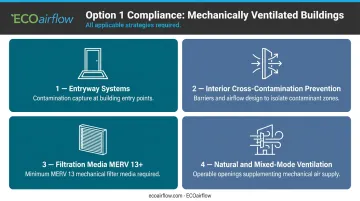
Entryway Systems
Permanently installed entryway systems — grates, grilles, slotted systems, rollout mats, or carpet tile specifically manufactured for entryway use — must be at least 10 feet (3 meters) long in the primary direction of travel at all regularly used exterior entrances.
Standard building carpeting does not qualify. These systems must be maintained weekly.
Once contaminants are prevented at the entry point, the next priority is keeping them from spreading through the building's internal spaces.
Interior Cross-Contamination Prevention
Spaces where hazardous gases or chemicals may be present — housekeeping areas, laundry rooms, copy rooms with large shared equipment — must be isolated using:
- Self-closing doors
- Deck-to-deck partitions or hard-lid ceilings
- Negative pressure exhaust systems
- Exhaust rate of 0.50 cfm per square foot or the applicable code rate, whichever is greater
- No recirculation of air from these spaces
With source control and isolation addressed, the filtration requirement governs what happens to airborne particulates that reach the HVAC system itself.
Filtration Media
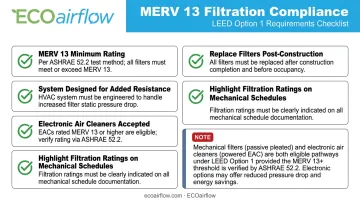
All HVAC equipment supplying outdoor air to occupied spaces must use filtration media rated at MERV 13 or higher (per ASHRAE 52.2). LEED v4.1 also accepts ISO 16890 ePM1 50% or higher as an equivalent standard.
Key operational requirements:
- HVAC systems must be designed or modified to accommodate the added resistance of MERV 13 media — this may require ductwork resizing or increased fan capacity
- Powered electronic air cleaners rated MERV 13 or higher can satisfy this requirement while operating at a fraction of the pressure drop of passive pleated filters, which helps preserve fan efficiency
- All filters must be replaced after construction completion and before occupancy
- Mechanical schedules must highlight MERV or filtration class ratings for all outdoor air supply units
Natural and Mixed-Mode Ventilation
Buildings using natural ventilation must demonstrate compliance with CIBSE AM10; mixed-mode systems reference CIBSE AM13. Both require design calculations and supporting narratives. Most mechanically ventilated commercial projects won't trigger this requirement — but confirming which ventilation type applies is an essential early step before finalizing your Option 1 compliance strategy.
Together, these four areas form the complete Option 1 framework. Addressing all applicable strategies — not just the ones that seem most relevant — is what LEED reviewers will verify.
LEED Enhanced IAQ Option 2: Additional Strategies to Maximize Points
Option 2 requires implementing just one strategy from the following list of five. Selecting the right one comes down to your building type, how the HVAC system is configured, and which approach aligns with your broader LEED credit strategy.
The five available strategies are:
- Exterior contamination prevention
- Increased ventilation (30% above ASHRAE 62.1 baseline)
- CO₂ monitoring
- Additional source control and monitoring
- Natural ventilation room-by-room calculations
Increased Ventilation
This strategy requires delivering outdoor air at 30% above the minimum rates established in the Minimum IAQ Performance prerequisite at all times during occupancy. Practical caution: For multiple-zone recirculating systems, increasing breathing-zone outdoor air by 30% often requires increasing the outdoor air intake by more than 30% due to ventilation efficiency calculations. Factor in the added conditioning load before committing — the energy penalty can offset gains in EA credit performance.
Exterior Contamination Prevention
Outdoor air intakes must be modeled using approved dispersion software to verify that pollutant concentrations comply with National Ambient Air Quality Standards (NAAQS). The process runs in two stages:
- Level 1 screening — modeled under worst-case meteorological conditions; sufficient if results are clearly compliant
- Level 2 screening — triggered when Level 1 results are borderline or noncompliant, using more detailed atmospheric modeling
Budget additional engineering time for this strategy. It's best suited to sites near roadways, loading docks, or industrial sources where intake contamination is a genuine risk — not a default choice for low-exposure sites.
The remaining three strategies — CO₂ monitoring, additional source control and monitoring, and natural ventilation room-by-room calculations — are covered in the following sections, along with guidance on when each makes the most sense for your project.
Filtration Media and MERV Ratings: The Critical Path to LEED Compliance
MERV (Minimum Efficiency Reporting Value), tested per ASHRAE 52.2, measures how effectively a filter captures particles across three size ranges:
| Particle Range | MERV 13 | MERV 14 | MERV 15 | MERV 16 |
|---|---|---|---|---|
| E1 (0.3–1.0 µm) | ≥50% | ≥75% | ≥85% | ≥95% |
| E2 (1.0–3.0 µm) | ≥85% | ≥90% | ≥90% | ≥95% |
| E3 (3.0–10.0 µm) | ≥90% | ≥90% | ≥90% | ≥95% |
Source: ASHRAE 52.2-2017
MERV 13 captures the fine particle range that includes PM2.5, bacteria, and combustion particles — the pollutants most directly linked to respiratory health outcomes. Higher ratings extend capture efficiency at the sub-micron level.
Mechanical vs. Electronic Filtration: The Energy Trade-Off
Traditional MERV 13+ pleated filters work through mechanical interception, which creates substantial resistance. As filters load with particulate, pressure drop increases — and so does fan energy demand. This creates a genuine tension between the EQ credit (requiring high filtration) and LEED's Energy & Atmosphere credits (rewarding low energy consumption).
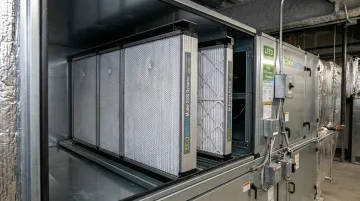
Electronic filtration resolves this tension. Systems using polarization technology can achieve MERV 13–16 performance at a fraction of the pressure drop of equivalent pleated media. ECOairflow's commercial products illustrate this clearly:
- Model 2300 (Dynamo™ 2"): MERV 14 certified under ASHRAE 52.2, with a pressure drop of 0.13–0.37 in.w.c. — compared to 0.6–1.2 in.w.c. for a conventional MERV 8 pre-filter + MERV 14 bag filter train
- M-Series™ 2" Hybrid: MERV 13A through 16A, Appendix J certified, maintaining full rated performance whether powered or unpowered
An independent 12-week study documented a 54% reduction in fan power consumption when ECOairflow's system replaced a conventional ASHRAE 170-compliant two-stage filter configuration — directly supporting LEED EA energy credit performance alongside the EQ credit.
That energy advantage only holds if the electronic system doesn't introduce new compliance risks. Ozone generation is the most common disqualifier.
The Ozone Risk with Electronic Air Cleaners
Some electronic air cleaners generate ozone as a byproduct — which would introduce a new pollutant into occupied spaces and undermine the credit's purpose. LEED-eligible electronic filtration must be zero-ozone verified.
The applicable standard is UL 2998, which validates that ozone emissions remain below 0.005 ppm (5 ppb) — one-tenth of the standard regulatory threshold. ECOairflow's commercial units (Model 2300 and M-Series) are UL 2998 certified at below 0.0005 ppm, ETL-listed by Intertek, covering both US and Canadian compliance.
Electronic filtration systems without this verification will fail LEED eligibility while simultaneously degrading indoor air quality.
Ozone compliance is straightforward to verify. Test dust composition is where specifying engineers need to dig deeper.
Verifying MERV Claims
ASHRAE 52.2-2017 specifies that loading dust must contain 72% ISO 12103-1 A2 fine test dust, 23% powdered carbon, and 5% milled cotton linters by weight. The carbon component is critical — it replicates real-world combustion byproducts and wildfire smoke that passive test dust does not.
Some manufacturers test electronic air cleaners in unpowered mode or with non-carbon alternate dust — conditions that don't reflect actual field performance. When reviewing product documentation, confirm:
- MERV rating achieved under powered operating conditions
- Test dust included the ASHRAE-specified carbon component
- Rating confirmed under ASHRAE 52.2 Appendix J protocol (if hospital or high-stakes application)
ECOairflow's M-Series maintains its full MERV rating under all three test conditions — powered, unpowered, and Appendix J — using ASHRAE-certified test dust throughout.
CO₂ Monitoring Requirements Under Enhanced IAQ Strategies
CO₂ monitoring is an Option 2 strategy — it earns 1 credit point when selected as the project's additional measure. The technical requirements are specific.
Placement and Coverage
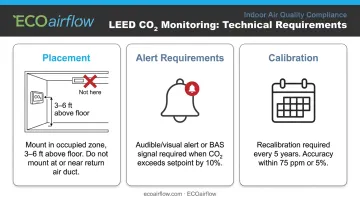
Monitors must be installed in all densely occupied spaces (occupant density greater than 25 people per 1,000 square feet), positioned 3 to 6 feet above the floor in the breathing zone. Return air duct placement does not satisfy this requirement — a USGBC addendum explicitly addresses this, clarifying that duct sensors measure diluted air rather than actual occupant exposure.
Alert and Calibration Requirements
These requirements govern how sensors must perform and how frequently they must be verified to maintain credit eligibility:
- Monitoring must trigger an audible or visual alert, or a building automation system signal, when CO₂ exceeds the calculated setpoint by more than 10%
- Setpoints are calculated using ASHRAE 62.1-2010 Appendix C (LEED v4) or ASHRAE 62.1-2016 Appendix D (LEED v4.1)
- Sensors must maintain accuracy within 75 ppm or 5% of the actual reading (whichever is greater)
- Recalibration is required at least every 5 years — failing to do so can jeopardize the credit during LEED recertification reviews
Integration with Demand-Controlled Ventilation
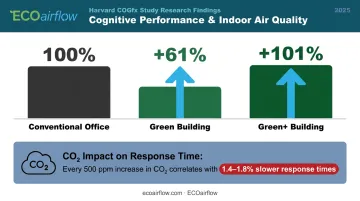
Connecting CO₂ sensors to HVAC controls for demand-controlled ventilation (DCV) is not required to earn the credit, but it represents a meaningful operational upgrade. Harvard research found that every 500 ppm increase in CO₂ correlated with 1.4–1.8% slower response times and 2.1–2.4% lower throughput in office workers. That makes real-time ventilation adjustment a tool with measurable impact on how people think and perform — not just a systems integration exercise.
Benefits of Earning Enhanced IAQ Credits for LEED Certification
The Certification Math
LEED certification thresholds are:
- Certified: 40–49 points
- Silver: 50–59 points
- Gold: 60–79 points
- Platinum: 80+ points
The Enhanced IAQ Strategies credit offers up to 2 standard points plus potential exemplary performance recognition. For projects sitting at 59 or 79 points before EQ finalization, these credits directly determine certification tier. Combined with EA credit performance from energy-efficient low-pressure-drop filtration, a well-executed filtration strategy can influence multiple credit categories simultaneously.
The Occupant Health Business Case
Harvard's COGfx study found cognitive function scores 61% higher in Green building conditions and 101% higher in Green+ conditions compared to conventional office environments. Lawrence Berkeley National Laboratory's review of ventilation research links lower ventilation rates to increased sick leave and respiratory illness absences across offices and schools.
For commercial offices, healthcare facilities, and schools, these outcomes translate directly to reduced absenteeism, lower liability exposure, and measurable productivity gains. That makes a strong business case on its own — before accounting for what the LEED points themselves unlock.
Frequently Asked Questions
What MERV rating is required for the LEED Enhanced Indoor Air Quality Strategies credit?
LEED requires a minimum of MERV 13 (per ASHRAE 52.2) for all filtration media supplying outdoor air to occupied spaces under Option 1. Ratings of MERV 14–16 are equally acceptable and provide improved capture efficiency at the sub-micron particle range.
How many LEED points can the Enhanced Indoor Air Quality Strategies credit earn?
The credit offers 1 point for Option 1, 1 point for Option 2, and exemplary performance recognition for achieving both options plus an additional Option 2 strategy — for a maximum of 2 standard certification points.
What is the difference between Option 1 and Option 2 in LEED Enhanced IAQ Strategies?
Option 1 requires implementing all applicable strategies for the building's ventilation type (entryway systems, filtration, cross-contamination prevention). Option 2 requires implementing one strategy from a defined list that includes CO₂ monitoring, increased ventilation, and exterior contamination prevention.
Do CO₂ sensors need to be recalibrated to maintain LEED credit?
Yes: sensors must be recalibrated at least every 5 years and must maintain accuracy within 75 ppm or 5% of the actual CO₂ level, whichever is greater. Build recalibration schedules into your O&M documentation from day one.
Can electronic air filtration systems qualify for LEED certification?
Yes, provided they meet MERV 13 or higher under ASHRAE 52.2 and carry UL 2998 zero-ozone verification. Systems that generate ozone contradict the indoor air quality goals the credit is designed to achieve and would not be appropriate for LEED-certified spaces.
Does high-efficiency filtration affect HVAC energy performance under LEED?
Traditional MERV 13+ pleated filters increase resistance and raise fan energy consumption. Advanced electronic filtration systems, such as ECOairflow's Model 2300 or M-Series Hybrid, achieve the required MERV ratings with significantly lower pressure drop — documented at 54% less fan power consumption — supporting LEED's EA energy credits alongside the EQ credit.