Introduction
Filtration compliance is now a lease negotiation point. Tenants ask for MERV ratings before signing. Healthcare accreditation bodies require documented filtration performance. Facility managers are caught between tightening ASHRAE standards, energy codes, and the real cost of high-MERV media filters that clog, restrict airflow, and drive up operating expenses.
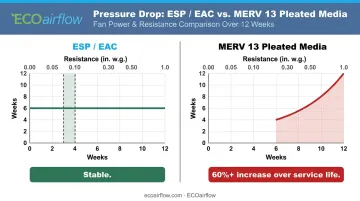
Standard pleated filters work — but dense media creates real tradeoffs. High-MERV disposable filters can reach 0.6–1.2 in. w.g. pressure drop as they load, increasing fan energy demand by 60% or more over a 12-week cycle (based on documented field performance comparisons against ASHRAE 52.2-rated configurations). Electrostatic precipitators offer a different approach: active electrical charging instead of passive mechanical blocking.
This guide covers what an electrostatic precipitator (ESP) is in a commercial HVAC context, how the two-stage process works, which configurations apply to which applications, and what facility managers need to evaluate — including the ozone question that complicates traditional ESP deployment in occupied buildings.
Key Takeaways
- ESPs capture fine airborne particles through a two-stage process: ionization, then collection — integrated directly into commercial HVAC airstreams
- Collection efficiency is device-specific; third-party testing on commercial units has documented 95% at 0.3 microns in single-pass configurations
- ESP's open-cell design creates 0.05–0.10 in. w.g. resistance versus 0.30–0.51 in. w.g. initial resistance for MERV 13-14 media
- Traditional ESPs generate ozone, a real hazard in occupied commercial buildings that requires direct evaluation before deployment
- Modern EAC technology — including ECOairflow's EPT platform — delivers MERV 13–16 performance with UL 2998 zero-ozone certification
What Is an Electrostatic Precipitator in HVAC?
An electrostatic precipitator is an electronic air filtration device that uses high-voltage electrical charges to ionize airborne particles and collect them on oppositely charged plates — removing fine particulate from the circulating airstream within a commercial HVAC system.
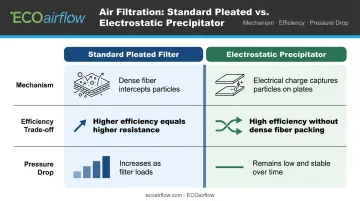
This sets ESPs apart from passive filtration in a fundamental way:
| Standard Pleated Filter | Electrostatic Precipitator | |
|---|---|---|
| Mechanism | Intercepts particles through dense fiber material | Charges particles and attracts them to collecting plates |
| Efficiency trade-off | Higher efficiency = higher airflow resistance | High efficiency without dense packing |
| Pressure drop | Increases as filter loads | Remains low throughout service interval |
Where ESPs Fit in a Commercial HVAC System
Commercial ESP units are installed in-duct — within the air handling unit (AHU) or as inline units within the duct run. They are not portable room devices. Sizing is based on system airflow (cubic feet per minute, or CFM) and face velocity across the filter section.
According to ASHRAE's classification of electronic air cleaners, a two-stage ESP has a discrete ionizing section followed by oppositely charged collecting plates — an externally powered system that is distinct from both passive media and portable ionizers. That distinction matters when specifying equipment: specifying an in-duct commercial ESP and purchasing a countertop air purifier are not interchangeable decisions — they are different product categories with different installation requirements, airflow ratings, and performance benchmarks.
How an Electrostatic Precipitator Works in a Commercial HVAC System
Charging Stage: Ionization of Airborne Particles
As air enters the ESP, high-voltage ionizer wires (maintained at several kilovolts) create a corona discharge that ionizes the surrounding air. Airborne particles passing through this field acquire an electrical charge, typically positive.
The charging stage addresses a broad particle size range. Peer-reviewed research on optimized in-duct two-stage ESPs documents effective collection across 0.1 to 3 microns at low face velocities, with specific tested results at 0.3 microns.
A 2018 manufacturer test on the Trion Air Boss T-Series (a commercial duct-capable unit) reported 95% efficiency at 0.3 microns and 675 CFM in single-pass configuration, and 99% at 825 CFM in double-pass. These are device-specific results, not universal benchmarks for all commercial ESPs.
Collection Stage: Plates Capture Charged Particles
Charged particles then enter a secondary electric field where alternating grounded and oppositely charged collection plates attract and trap them. Clean air exits on the downstream side and re-enters the commercial HVAC distribution system.
ASHRAE Standard 52.2 measures collection efficiency by comparing upstream and downstream particle counts across 12 size bins from 0.30 to 10 microns — fractional efficiency derived from what enters versus what exits the unit.
The Open-Cell Advantage
The plate-based collection design has a direct impact on operating costs. Parallel plates create far less airflow resistance than dense fiber media — and that difference compounds over time in a continuously running commercial system.
| Filter Type | Initial Resistance | Recommended Final Resistance |
|---|---|---|
| ESP (electrostatic precipitator) | 0.05–0.10 in. w.g. | — |
| MERV 13 pleated media | 0.30 in. w.g. (clean) | 1.0 in. w.g. |
For commercial HVAC systems running year-round, lower static pressure translates directly to reduced fan motor load. Independent testing of ECOairflow's commercial EAC units has documented a 54% reduction in fan power consumption over 12 weeks compared to an ASHRAE 170-compliant MERV 8 pre-filter plus MERV 14 bag filter configuration.
Types of Commercial Electrostatic Precipitator Systems
| Type | Primary Application | Key Characteristic |
|---|---|---|
| Plate (Dry) ESP | Offices, retail, healthcare | Lower ozone output; handles dry particulates |
| Wet ESP (WESP) | Kitchen exhaust, food processing | Water-flush removes grease and oil mist |
| Two-Stage In-Duct EAC | Offices, hospitals, airports, commercial HVAC | Cleanable/replaceable collection cells; sized to AHU |
Plate (Dry) ESP
The most common commercial HVAC configuration: vertical ionizer wires followed by alternating charged and grounded plates. Suited for dry particulates — dust, smoke, pollen. Produces lower ozone output relative to other ESP variants. Used in offices, commercial buildings, and some healthcare facilities.
Wet Electrostatic Precipitator (WESP)
WESPs use water sprays or condensation to flush collected particles — including sticky grease and oil mist — from collection surfaces into a sump. Commercial kitchen exhaust is their primary application, where grease loads make dry plate cleaning impractical. They are not standard supply-air devices in commercial AHUs.
Two-Stage In-Duct Electronic Air Cleaners
The most relevant configuration for standard commercial HVAC integration. A separate charging section and collection section are housed in a duct-compatible enclosure. Collection cells are typically cleanable aluminum construction rather than disposable media. Sized to match AHU airflow specifications.
Modern commercial electronic air cleaners fall into this category, including ECOairflow's Model 2300 and M-Series Hybrid. Both use Electronic Polarization Technology (EPT) rather than traditional ionizer wire architecture.
Benefits of Electrostatic Precipitators for Commercial HVAC
High Particle Capture Across a Wide Size Range
Commercial-grade electronic air filtration systems can capture particles well below the 0.3-micron floor that ASHRAE 52.2 measures. ECOairflow's EPT-based commercial units — the Model 2300 and M-Series Hybrid — are documented to capture particles as small as 0.001 microns, spanning viruses, wildfire smoke, ultra-fine traffic-related particulate, and radon daughter progeny.
Independent testing comparing EPT-based filtration to HEPA found 74.73% capture of PM0.1 ultra-fine particles, versus HEPA's 49.19% under the same controlled conditions — making EPT approximately 50% more effective than HEPA in the sub-0.1 micron range where the most hazardous airborne particles reside.
Energy Savings Through Low Pressure Drop
The pressure drop difference between EPT-based filtration and traditional media is significant at scale:
| Configuration | Pressure Drop | Fan Power Impact |
|---|---|---|
| Model 2300 Dynamo (EPT) | 0.13–0.37 in. w.c. | Stable across service life |
| MERV 8 + MERV 14 bag filter | 0.6–1.2 in. w.g. | 60%+ increase as filters load |
An independent 12-week study on identical air handlers documented a 54% reduction in total fan power consumption when the Model 2300 replaced a traditional MERV 8 + MERV 14 bag filter configuration. For airports, casinos, and hospitals running HVAC around the clock, that reduction translates directly to lower utility bills every billing cycle.
Reusable Collection Cells Reduce Operating Costs
Traditional disposable MERV media must be purchased, replaced, and landfilled on a recurring cycle. ESP-based systems with cleanable aluminum plates, or electronic air cleaners with replaceable glass-fiber pads, eliminate most of that waste stream.
The Model 2300 uses a permanent aluminum frame as a one-time capital purchase. The replaceable glass-fiber mesh pad — swapped every 3–6 months in commercial applications — is recyclable as post-consumer glass waste in most municipalities. For multi-AHU deployments across office towers, airports, or hospital campuses, that means fewer purchase orders, less disposal coordination, and a reduced recurring media budget compared to conventional filter trains.
MERV Performance Alignment for Commercial Compliance
Commercial facilities frequently carry minimum MERV requirements under ASHRAE 62.1, ASHRAE 170 (healthcare), or tenant lease specifications. Advanced electronic filtration systems can meet these benchmarks with certified data.
ECOairflow's M-Series Hybrid holds MERV 13A through 16A certification under ASHRAE 52.2 Appendix J — tested powered, unpowered, and under in-situ conditioning. For healthcare applications: MERV 14A is approved for emergency rooms and invasive procedure rooms; MERV 16A for operating rooms. The "A" suffix confirms Appendix J compliance, which is increasingly required in hospital and government procurement specifications.
Ozone Risks and Limitations of Traditional ESP in Occupied Commercial Spaces
Ozone generation has historically been the primary barrier to traditional ESP deployment in occupied commercial buildings — and it's worth understanding exactly why.
How Traditional ESPs Produce Ozone
The corona discharge in the ionization stage splits oxygen molecules (O₂), forming ozone (O₃). In industrial settings, ventilation typically manages this. In occupied commercial buildings — offices, retail, hospitals, schools — ozone accumulation is a genuine health concern. The EPA documents that low ozone exposure can cause chest pain, coughing, shortness of breath, and throat irritation, and can worsen chronic respiratory disease. The EPA has stated that no federal agency has approved ozone-generating air cleaners for occupied spaces.
The Regulatory Landscape
Two standards define the compliance benchmarks commercial buyers should require:
- California Air Resources Board (CARB): Electronic air cleaners sold or leased in California must not exceed 0.050 ppm (50 ppb) ozone concentration, effective 2010
- UL 2998: "Zero ozone" verification means measured ozone is at or below the method's 0.005 ppm (5 ppb) detection limit — one-tenth of the CARB threshold
UL 2998 certification (validated by UL Solutions or Intertek) is the standard commercial buyers should require for any electronic air cleaner used in occupied spaces.
Additional Performance Constraints
Beyond ozone, traditional ESPs carry additional constraints:
- Particulate-only capture — VOCs, chemical gases, and other gaseous pollutants pass through untreated
- Maintenance-sensitive efficiency — plate fouling from missed cleaning cycles causes measurable drops below rated MERV performance
- Higher initial capital cost than standard filter housings
Modern Electronic Filtration as the Alternative
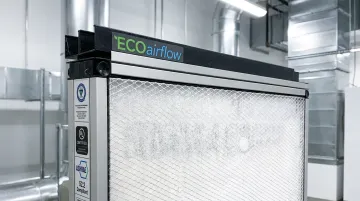
ECOairflow's patented Electronic Polarization Technology (EPT) addresses the ozone concern directly. The Model 2300 and M-Series Hybrid are ETL Listed and UL 2998 Zero Ozone Certified, with ozone emissions verified below 0.0005 ppm — one-tenth of the UL 2998 threshold and far below CARB limits. The system runs at 2 watts or less of electronics power draw. For facility managers specifying air filtration in continuously occupied spaces, that combination — certified zero ozone, MERV 13–16 performance, and sub-2-watt power draw — removes the compliance barriers that have historically kept electronic filtration off the shortlist.
Maintenance and Cost Considerations for Commercial ESP
Cleaning Schedules and Performance Degradation
Traditional ESP collection plates require periodic cleaning. As plates accumulate particulate, collection efficiency drops — a system running on a missed cleaning schedule will underperform its rated specification. Air quality engineering guidance notes that cells in thick smoke or dusty service may need washing as often as twice weekly, while lighter-duty applications may permit one to two months or longer between cleanings.
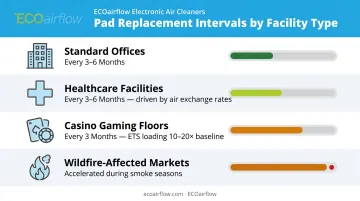
ECOairflow's commercial units eliminate the washing requirement. The glass-fiber mesh collection pads are replaced, not washed — a simpler maintenance model for commercial facilities. General replacement intervals by environment:
- Standard offices: Every 3–6 months
- Healthcare facilities: Every 3–6 months (interval driven by clinical space air exchange rates)
- Casino gaming floors: Trend toward every 3 months given continuous ETS loading 10–20× above commercial baseline
- Wildfire-affected markets (Western US): Accelerated replacement during smoke seasons
Staying on schedule across multiple units is straightforward — ECOairflow offers an email pad-reminder service and recurring shipment subscription at ecoairflow.com/email-reminders for multi-unit commercial deployments.
Total Cost of Ownership vs. Disposable Filter Systems
A direct TCO comparison requires facility-specific pricing for unit capital cost, installation, pad replacement, and energy — figures that vary by air handler count, CFM, and application. Available data shows:
- ECOairflow's commercial frame is a one-time capital purchase; only the glass-fiber pad recurs as operating expense
- The independent study's 54% fan power reduction over 12 weeks is the primary energy savings driver
- Traditional MERV 8 + MERV 14 bag filter configurations show 60%+ fan power increase as they load — a cost that compounds over their service life
- MERV 13–14 media initial resistance of 0.30–0.51 in. w.g. climbs toward a recommended final resistance of 1.0–1.5 in. w.g.
For a facility-specific TCO analysis covering capital cost, pad subscription pricing, and projected energy savings based on your air handler count and current filter configuration, contact ECOairflow at 1-877-347-3569 or sales@ecoairflow.com.
Installation and Sizing Requirements
Commercial ESP systems must be professionally sized. Undersized units fail to achieve rated efficiency at design airflow; oversized units waste capital. Sizing inputs include:
- System CFM and face velocity (FPM)
- Filter bank physical dimensions
- Contaminant type and load (office dust vs. casino ETS vs. hospital bioaerosols)
- MERV specification required (14A vs. 16A for healthcare; MERV 14 for general commercial)
ECOairflow's Model 2300 and M-Series are available in all industry-standard sizes, including custom dimensions for non-standard installations. Commercial specifications are handled through direct sales and authorized HVAC contractors. ECOairflow provides submittal documentation, Appendix J certification data, and PM0.1 lab-test reports on request for specifying engineers.
Frequently Asked Questions
What is an electrostatic precipitator in HVAC?
An electrostatic precipitator (ESP) is an electronic air filtration device installed in commercial HVAC ductwork that uses high-voltage electrical charges to ionize airborne particles, then captures them on oppositely charged plates. Unlike passive media filters, ESPs actively charge particles rather than mechanically blocking them — delivering high capture efficiency with lower airflow resistance.
Do electrostatic precipitators produce ozone in commercial buildings?
Traditional ESPs generate ozone as a byproduct of the corona discharge ionization process — a health risk in occupied buildings. Zero-ozone certified systems verified under UL 2998 address this directly and are the correct specification for any occupied commercial space.
How often do electrostatic precipitators need to be cleaned in a commercial HVAC system?
It depends on particulate load. Traditional ESP plates require cleaning anywhere from twice weekly (heavy smoke) to every one to two months in lighter applications. ECOairflow's commercial units use replaceable collection pads on a 3–6 month cycle, eliminating the manual plate-washing requirement.
What MERV rating does an electrostatic precipitator achieve?
ESP performance varies by design and manufacturer. Advanced commercial electronic air filtration systems can achieve MERV 13–16 certification under ASHRAE 52.2. ECOairflow's M-Series Hybrid is certified MERV 13A–16A under Appendix J. Always request verified MERV testing data — including the test condition (powered, unpowered, Appendix J) — before specifying a system.
Are electrostatic precipitators suitable for hospitals and healthcare facilities?
Yes, with important qualifications. Healthcare applications require zero-ozone certified units, MERV performance verified under ASHRAE 52.2 Appendix J, and performance assurance both powered and unpowered. ECOairflow's M-Series Hybrid meets ASHRAE 170 and CSA Z317.2 requirements for emergency rooms (MERV 14A) and operating rooms (MERV 16A).
What is the difference between an electrostatic precipitator and a standard HVAC media filter?
Standard media filters passively intercept particles through dense fiber material, creating pressure drop that increases as the filter loads with debris. ESPs actively charge and attract particles using electrical fields, maintaining lower, more stable pressure drop throughout their service life — with reusable or long-life collection cells rather than recurring disposable filter costs.