Introduction
Most commercial buildings recirculate air continuously — and the filters doing that work weren't designed for the particles causing the most damage. PM1.0 particles, those smaller than 1 micrometer, pass straight through standard MERV 8–11 filters without resistance. They don't settle. They don't get caught on surfaces. They just keep circulating, inhaled repeatedly by every occupant in the building.
For facility managers and HVAC contractors, the problem is invisible by design. There's no visible dust, no obvious malfunction — just elevated sick days, IAQ complaints, and potential compliance gaps building up without a clear source.
This guide covers:
- What PM1.0 is under ASHRAE and ISO frameworks
- How it compares to coarser particle categories
- Which filter technologies genuinely capture it at commercial scale
- How to evaluate and maintain the right solution for your application
Key Takeaways
- PM1.0 (under 1 micron) is classified as the E1 range under ASHRAE 52.2 — the most demanding and health-relevant particle size category
- MERV 13–16 is required for effective E1 particle capture; most commercial buildings still run MERV 8–11
- Electronic Polarization Technology (EPT) captures PM1.0 at high efficiency with significantly lower pressure drop than dense mechanical filters
- A 2021 longitudinal study linked indoor PM2.5 increases to measurable cognitive performance declines in office workers across six countries
- Select filters based on MERV methodology, rated-airflow pressure drop, ozone compliance, and application-specific standards
What Is PM1.0 and Why Does It Matter in Commercial HVAC?
Defining PM1.0
PM1.0 refers to particulate matter with an aerodynamic diameter under 1 micrometer — roughly 1/70th the width of a human hair. It's a size classification, not a product category.
Under ISO 16890, PM1.0 falls within the ePM1 efficiency group, defined by a 50% cutoff at 1 micrometer aerodynamic diameter. ASHRAE 52.2 uses slightly different terminology — its smallest test bin, E1, spans 0.30–1.0 micrometers. These aren't interchangeable labels, but they track the same particle size range.
Where PM1.0 Comes From in Commercial Buildings
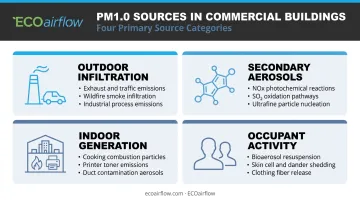
Commercial buildings sit at the intersection of multiple PM1.0 sources:
- Outdoor infiltration — vehicle exhaust, diesel generators, wildfire smoke, industrial emissions
- Secondary aerosols — nitrogen oxide and sulfur dioxide gases that react in the atmosphere to form ultrafine particles
- Indoor generation — tobacco and e-cigarette aerosols, cooking emissions, printer toner, HVAC duct contamination
- Occupant activity — exhaled bioaerosols, skin particles, clothing fibers in high-density spaces
Once PM1.0 enters a commercial HVAC system, it doesn't settle. Unlike larger particles that drop out of suspension, ultrafine particles remain airborne and recirculate through every supply and return cycle — indefinitely, unless the filter is capturing them.
The Building Management Problem
That recirculation problem is compounded by a widespread filter gap. Most commercial buildings operate on MERV 8–11 filters. Under ASHRAE 52.2, MERV 8 requires only 70% efficiency for E3 particles (3–10 micrometers) and has no minimum requirement for E1 at all. PM1.0 passes through untouched.
The downstream effects are financial, not just clinical:
- Increased occupant sick days and complaints
- Risk to LEED certification or ASHRAE 62.1 compliance standing
- Potential liability in high-profile occupancy settings like hospitals or airports
Large-scale commercial HVAC systems add another constraint: any filter solution must perform at high air volumes without spiking static pressure and driving up fan energy costs. Understanding that pressure-drop penalty is essential before evaluating which filter technologies actually close the PM1.0 gap.
PM1.0 vs. PM2.5 vs. PM10: What the Size Difference Actually Means
Size, Sources, and Health Penetration
| Particle Category | Size | Typical Sources | Body Penetration |
|---|---|---|---|
| PM10 | ≤10 microns | Pollen, dust, mold spores | Nose and upper throat |
| PM2.5 | ≤2.5 microns | Bacteria, combustion particles, smog | Pulmonary alveoli |
| PM1.0 | ≤1 micron | Viruses, soot, tobacco aerosols, radon progeny | Crosses into bloodstream |
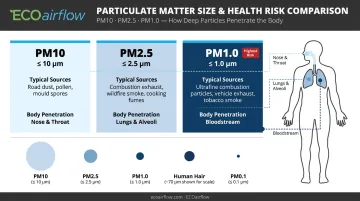
These categories are cumulative — PM1.0 is the most hazardous subset within PM2.5, not a separate scale. The EPA notes that fine particles affect cardiovascular health through systemic inflammation, autonomic nervous system disruption, and possible translocation into circulation: pathways that intensify as particle size decreases.
Research into ultrafine particles (≤0.1 microns) links this size range to translocation from lungs to other organs, endothelial dysfunction, and coagulation changes — compounding the case for filtration that reaches below PM1.0.
What This Means for HVAC Filter Selection
For commercial HVAC specification, that health risk gradient maps directly onto filter selection. The MERV system tracks this gradient:
- PM10 capture: MERV 6–8 (E3 efficiency range)
- PM2.5 capture: MERV 13+ begins addressing the E2 range (1.0–3.0 microns)
- PM1.0 capture: MERV 13–16, with E1 minimum efficiencies of 50%, 75%, 85%, and 95% respectively
MERV 16 is the first rating requiring 95% E1 efficiency — but MERV 13, 14, and 15 also have documented E1 capture rates. The common shorthand that "PM1.0 requires MERV 16" overstates it. What it actually requires is a filter with a verified E1 efficiency rating, and that starts at MERV 13.
Health and Compliance Risks for Commercial Facilities
Occupant Health: What the Research Shows
A 2021 longitudinal study following 302 office workers across 42 buildings in six countries found that each 8.8 μg/m³ interquartile increase in indoor PM2.5 was associated with measurably longer cognitive response times and lower throughput scores. The finding was consistent across a diverse international sample: worse air quality correlates directly with slower thinking.
For hospitals and high-occupancy commercial facilities, the stakes compound. PM1.0 can carry viable bacterial and viral particles, and in settings where recirculation is continuous, inadequate filtration creates cross-contamination conditions that no ventilation rate adjustment alone can correct.
facilities to document filtration performance.
- LEED v4.1: Enhanced Indoor Air Quality Strategies accepts MERV 13 under ASHRAE 52.2 or ISO ePM1 50% for applicable systems.
- ASHRAE 170: Governs healthcare facilities specifically — MERV 14 baseline for patient-care areas, HEPA for select protective environments.
Filter Technologies for PM1.0 Capture in Commercial HVAC
Three main technology categories address PM1.0 in commercial HVAC applications. The right choice depends on air volume, pressure drop tolerance, application requirements, and budget.
Mechanical High-Efficiency Filters (MERV 13–16 and HEPA)
Dense mechanical filters — pleated mini-pleats, bag filters, HEPA — capture PM1.0 through diffusion and inertial impaction. MERV 16 achieves ≥95% E1 efficiency; HEPA achieves 99.97% at 0.3 microns.
The tradeoff is pressure drop. Published test data for one commercial mini-pleat product line shows resistance rising from 0.18 in. w.g. at MERV 11 to 0.57 in. w.g. at MERV 16, both at 500 FPM. A traditional MERV 8 pre-filter + MERV 14 bag filter train — the standard hospital configuration — typically runs 0.6–1.2 in. w.g. That pressure load drives fan energy consumption up significantly, and it increases further as filters load with particulate over time.
Electronic Polarization Technology (EPT)
EPT works differently from both mechanical filtration and traditional electrostatic precipitation. Rather than blocking particles physically or collecting them on charged metal plates, EPT polarizes the media fibers themselves — creating an electromagnetic field across the depth of a glass-fiber mesh pad that actively attracts charged particles.
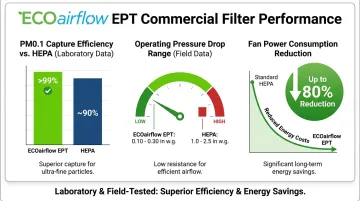
ECOairflow's commercial filters use this mechanism to capture particles as small as 0.001 microns. Independent lab testing and field data show the practical impact:
- 74.73% PM0.1 capture efficiency — vs. 49.19% for HEPA under identical controlled conditions
- 0.13–0.37 in. w.c. operating pressure drop — roughly three to four times lower than a conventional MERV 14 filter bank
- 54% reduction in fan power consumption — documented over 12 weeks vs. an ASHRAE 170-compliant MERV 8 + MERV 14 hospital configuration
Those energy savings come without the ozone penalty that disqualifies many electrostatic alternatives. Traditional electrostatic precipitators produce ozone as a byproduct — a compliance issue in occupied spaces. ECOairflow's commercial line carries Intertek ETL UL 2998 Zero Ozone Verification, with emissions confirmed below 0.0005 ppm, satisfying ASHRAE 62.1-2022 Section 5.7.1 requirements for air-cleaning devices.
Hybrid and Activated Carbon Systems
For applications where gaseous pollutants accompany PM1.0 — casino floors, laboratories, facilities near industrial sources — hybrid filters combining activated carbon media with high-efficiency particulate capture address both problems . Treat it as a secondary layer, not a standalone PM1.0 solution. The particulate filtration still needs to meet E1 requirements; carbon handles VOCs and odors that particle filters don't address.
Choosing the Right PM1.0 Filter for Your Commercial System
Key Selection Criteria
- Verified MERV rating under ASHRAE 52.2 — not self-reported, not tested with non-carbon substitute dust. True MERV certification uses ASHRAE-certified test dust with a carbon component, which is why many electronic air cleaners fail to maintain their ratings under real-world conditions.
- Appendix J certification — ASHRAE 52.2 Appendix J conditioning simulates field exposure before testing, revealing whether a filter's efficiency degrades as it loads. For hospital and critical-environment procurement, an Appendix J (MERV-A) rating is the difference between documented in-service performance and a best-case lab result.
- Pressure drop at rated airflow — confirmed at 500 FPM for commercial applications. Numbers from different face velocities are not comparable.
- Ozone emission status — required for ASHRAE 62.1 compliance; critical in continuously occupied spaces.
- Application-specific standards — ASHRAE 170 for healthcare, LEED v4.1 documentation for certified buildings.
ECOairflow's M-Series Hybrid maintains its full MERV 13–16 rating whether powered, unpowered, or under Appendix J conditioning. In hospitals, where power interruption cannot compromise air quality, that consistency is a procurement requirement, not a preference. The standard Model 2300 achieves MERV 14 powered but carries no Appendix J certification and is not suitable for medical treatment rooms.
Red Flags When Evaluating Filter Claims
- Efficiency ratings reported without specifying face velocity
- MERV testing conducted unpowered or with non-carbon test dust
- PM1.0 performance claims without third-party ASHRAE 52.2 or ISO 16890 certification
- No differentiation between initial lab efficiency and in-service performance
Request test certificates and confirm whether ratings use ASHRAE 52.2 or ISO 16890 methodology. Ask specifically for Appendix J (MERV-A) results if your application is healthcare or any continuously occupied critical environment.
PM1.0 Filter Maintenance and Lifecycle Costs
Replacement Scheduling
Calendar-only replacement schedules don't account for actual filter loading. ASHRAE 170 requires pressure-drop-based replacement for healthcare filter banks; ASHRAE 180 mandates at least quarterly checks for commercial HVAC with documented records.
For PM1.0 filters in commercial applications:
- High-occupancy urban environments: Plan for 3-month replacement cycles as a baseline
- Standard commercial loads: 3–6 months depending on local air quality and occupancy density
- Casino environments: Shorter intervals due to extreme ETS loading (tobacco smoke concentrations 10–20x typical commercial levels)
- Wildfire smoke seasons: Accelerated loading requires proactive monitoring regardless of filter type
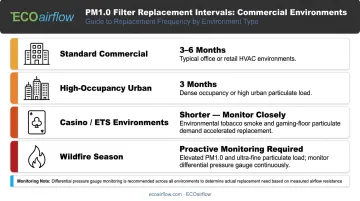
Install differential pressure gauges on filter banks rated above MERV 12. Pressure readings tell you more than a calendar does.
Total Cost of Ownership
The purchase price of a high-MERV filter is the least useful number for commercial procurement decisions. Three cost drivers determine the real picture:
- Replacement frequency and labor for changeouts
- Fan energy cost over the filter's service life (mechanical filters increase resistance as they load)
- Disposal costs for full filter cartridge replacement vs. pad-only systems
ECOairflow's permanent aluminum frame model changes this calculation: only the glass-fiber pad is replaced periodically, not the housing. The M-Series pad also replaces both the pre-filter and final filter stages in a single swap, reducing labor per changeout. Pads can be recycled as post-consumer glass waste in most municipalities.
Documentation for Compliance Records
For hospitals, LEED buildings, and federal facilities, maintaining a filter log with installation dates, MERV certification records, and replacement history is essential for audits. ETL-listed and Appendix J-certified filters simplify this process — the documentation already exists and can be requested directly from the manufacturer.
ECOairflow provides the following on request:
- MERV test certificates (ASHRAE 52.2)
- Appendix J certification data
- PM0.1 lab-test reports
- LEED EQ submittal sheets
- UL 2998 ozone compliance records
- ASHRAE 62.1/90.1/170/241 documentation
Contact ECOairflow at 1-877-347-3569 or customerservice@ecoairflow.com.
Frequently Asked Questions
What is the difference between PM10 and PM2.5 filters?
PM10 filters (typically MERV 6–8) capture coarser particles like pollen and dust down to 10 microns. PM2.5 filters (MERV 13+) target finer combustion particles and bacteria down to 2.5 microns. PM2.5 filtration is the minimum threshold recommended for most commercial HVAC applications where occupant health is the priority.
What does PM10 mean in an HVAC filter rating?
PM10 refers to particulate matter with a diameter of 10 micrometers or less, a particle size classification, not a brand. Under ISO 16890, a filter's efficiency at capturing PM10 is one of three size ranges tested. PM1.0 efficiency (ePM1) is the most demanding and most health-relevant benchmark in that framework.
What is the safe level of PM1.0 indoors?
WHO's 2021 guidelines set annual mean limits of 5 μg/m³ for PM2.5 and 15 μg/m³ for PM10. No standalone numerical PM1.0 guideline exists yet — but since PM1.0 is measured within PM2.5, the PM2.5 limit functions as the working benchmark for commercial indoor air quality targets.
What is a PM0.1 filter?
PM0.1 (ultrafine particles or nanoparticles) refers to particles under 0.1 microns. Standard MERV testing stops at 0.3 microns, so no mechanical filter carries a certified PM0.1 rating. Electronic polarized media filters can capture particles well below this threshold — ECOairflow's Model 2300 achieves 74.73% PM0.1 capture in independent lab testing, compared to 49.19% for HEPA.
What MERV rating is needed to capture PM1.0 in commercial HVAC?
MERV 13 is the first rating with a verified E1 minimum efficiency (50%); MERV 16 reaches 95%. Electronic polarized media filters certified at MERV 13–16 under ASHRAE 52.2 Appendix J match or exceed this range at significantly lower pressure drop, making them a more energy-efficient commercial option than dense mechanical filters.
How often should PM1.0 filters be replaced in commercial buildings?
Replacement frequency depends on filter type, occupancy load, and local air quality. Mechanical MERV 16 filters in high-occupancy or urban environments typically need replacement every 3–6 months. ECOairflow's EPT-based commercial systems follow the same interval for pad replacement. Monitor via differential pressure readings rather than fixed calendar schedules alone.