According to the EPA, most HVAC manufacturers recommend replacing filters every 60–90 days—yet many homeowners don't think twice about which filter goes back in.
This guide covers what each rating actually means, how they compare across filtration efficiency, airflow resistance, and cost, and a clear framework for choosing the right option for your specific situation.
Key Takeaways
- MERV 8 captures particles 3–10 microns (dust, pollen, mold spores, pet dander)—suited for standard homes with no respiratory concerns
- MERV 13 adds capture of bacteria, smoke, and virus carriers down to 0.3 microns—recommended by ASHRAE and CDC for health-sensitive spaces
- Denser MERV 13 media increases airflow resistance—verify your HVAC system's compatibility before upgrading
- Choosing the right filter means weighing occupant health, environment, and HVAC capacity together, not just filtration rating
- Commercial and healthcare facilities needing MERV 13–16 performance without pressure drop penalties should consider electronic air filtration
MERV 8 vs MERV 13: Quick Comparison
MERV stands for Minimum Efficiency Reporting Value, a standardized scale developed by ASHRAE (American Society of Heating, Refrigerating and Air-Conditioning Engineers) under Standard 52.2. The scale runs from 1 to 16, with higher numbers indicating finer filtration.
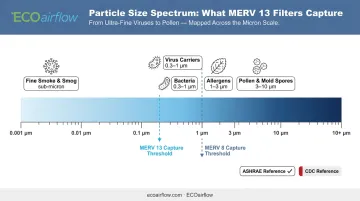
The ASHRAE 52.2 framework tests filters across three particle size ranges: 0.3–1.0 microns, 1.0–3.0 microns, and 3.0–10.0 microns. Each range corresponds to different real-world contaminants, which is why the rating you choose matters.
Both MERV 8 and MERV 13 outperform basic fiberglass filters (MERV 1–4), but they serve distinct purposes. Here's how they compare across key specifications:
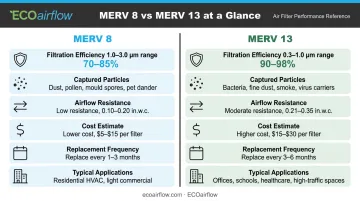
| Attribute | MERV 8 | MERV 13 |
|---|---|---|
| Filtration efficiency (3–10 µm) | ≥70% | ≥90% |
| Filtration efficiency (1–3 µm) | ≥20% | ≥85% |
| Filtration efficiency (0.3–1 µm) | No minimum requirement | ≥50% |
| Particles captured | Dust, pollen, mold spores, pet dander, lint | All MERV 8 particles plus bacteria, smoke, virus carriers, fine allergens |
| Airflow resistance | Low | Higher (denser media) |
| Filter cost | Lower per unit | Higher per unit |
| Replacement interval | Every 2–3 months | Varies by thickness and environment |
| Typical applications | Standard residential, light commercial | Health-sensitive homes, healthcare, schools |
What Is a MERV 8 Filter?
MERV 8 is a mid-range filter verified to capture at least 70% of particles in the 3–10 micron range and 20% of particles in the 1–3 micron range. It has no verified minimum for the 0.3–1 micron band — the size range where bacteria and virus carriers are found.
What MERV 8 captures:
- Household dust and lint
- Pollen
- Mold spores
- Dust mites
- Pet dander
What MERV 8 does NOT reliably capture: bacteria, fine smoke particles, virus carriers, and sub-micron allergens. These require finer filtration.
Operational Benefits
MERV 8's key advantage is compatibility. Both Carrier and American Standard identify MERV 8 to 13 as the recommended residential range, placing MERV 8 at the lower end of what HVAC professionals consider appropriate for home use.
The practical benefits follow from that low airflow resistance:
- Blower motor operates with minimal restriction, reducing energy consumption
- Less strain on older systems with weaker fans
- Lower per-unit cost and straightforward replacement every 2–3 months
Use Cases for MERV 8
Those operational characteristics make MERV 8 a fit for specific situations. It's the right choice when:
- No occupants have chronic respiratory conditions, allergies, or asthma
- No pets in the home
- Outdoor air quality is generally good (no wildfire proximity, no heavy traffic nearby)
- The HVAC system is older or the manufacturer's manual specifies a MERV ceiling below 13
It's the default recommendation across North America for residential and light commercial settings where air quality demands are moderate. If none of the above conditions apply, MERV 8 will handle the job without overworking your system.
What Is a MERV 13 Filter?
MERV 13 is a high-efficiency filter with verified minimums of ≥50% at 0.3–1.0 microns, ≥85% at 1.0–3.0 microns, and ≥90% at 3.0–10.0 microns. That sub-micron capture is what separates it from MERV 8 in practical terms.
That range covers particles MERV 8 passes through entirely — bacteria, fine smoke (wildfire, tobacco, cooking), virus carriers, smog, and microscopic allergens. This is why both ASHRAE's Epidemic Task Force and CDC/NIOSH now reference MERV 13 as a baseline for occupied buildings. ASHRAE's filtration guidance specifically recommends MERV 13 or better to reduce airborne pathogen concentrations; CDC/NIOSH echoes this, advising the highest efficiency filter your HVAC system can handle.
The Airflow Trade-Off
MERV 13 filters are denser. That density creates more resistance to airflow—what engineers call pressure drop. According to Carrier, higher-rated filters can restrict airflow if the system is not designed for them. The consequences of a mismatch:
- Blower motor overheating
- Reduced airflow across heat exchangers
- Higher energy bills
- In severe cases, equipment failure
This doesn't mean MERV 13 is dangerous—it means HVAC compatibility matters before upgrading. Replacement intervals depend on filter thickness and environment; thin 1-inch pleated MERV 13 filters may need replacement every 30–90 days, while 4-inch media filters can last 6–12 months.
Use Cases for MERV 13
MERV 13 is appropriate when:
- Any occupant has allergies, asthma, or is immunocompromised
- The home has multiple pets
- You live in a wildfire-prone region (the CDC specifically recommends MERV 13 or higher for wildfire smoke)
- You're near major roads, industrial zones, or dense urban areas with high PM2.5 levels
- The space requires infection control standards—healthcare facilities, schools, dental offices
Before installing MERV 13 in an older system, check the manufacturer's manual for the maximum recommended MERV rating. If the system is more than 10–15 years old, consult an HVAC technician before installing.
MERV 8 vs MERV 13: Which One Is Right for You?
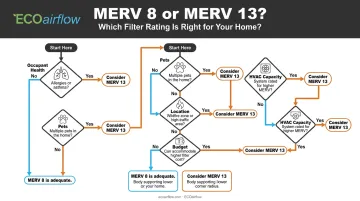
The honest answer: neither is universally better. The right filter is the one that matches your occupant health needs, your environment, and what your HVAC system can actually handle.
Decision Factors to Evaluate
- Occupant health — Does anyone have allergies, asthma, or a compromised immune system?
- Pets — Multiple pets significantly increase particulate load
- Location — Wildfire regions, high-traffic corridors, industrial proximity all raise the stakes
- HVAC system capacity — Age alone isn't the threshold; what matters is whether the system can accommodate higher-MERV media without performance loss
- Budget — Higher MERV filters cost more per unit; system modifications (if needed) add further cost
When to Choose MERV 8
- No occupants with respiratory conditions
- No pets, or a single low-shedding pet
- Good regional air quality, no wildfire proximity
- Older HVAC system or one where the manufacturer specifies a MERV ceiling below 13
When to Choose MERV 13
- Any occupant with allergies, asthma, or immune vulnerabilities
- Multiple pets
- Wildfire-prone area or near major roads and industrial zones
- Healthcare, school, or laboratory settings requiring infection control standards
Addressing the Compatibility Concern
Switching from MERV 8 to MERV 13 without system evaluation creates a real risk. The denser media increases pressure drop, which forces the blower motor to work harder. Over time, that added strain reduces system efficiency and can cause overheating.
Solutions exist—increasing filter area, adjusting motor speed, or in some cases replacing the motor—but these require professional assessment. The practical recommendation: verify your system's maximum MERV rating in the manufacturer documentation, and consult an HVAC technician before upgrading if there's any uncertainty.
An Alternative Worth Considering: Electronic Air Filtration
For commercial facilities, healthcare settings, or any application where MERV 13–16 performance is required without the pressure drop penalty of dense pleated filters, electronic air filtration systems are a compelling option.
ECOairflow's M-Series Hybrid illustrates what's possible. Certified MERV 13–16 under ASHRAE 52.2 (including Appendix J testing), it holds its full rating whether powered or unpowered. Key performance figures from independent testing:
- Pressure drop: 0.13–0.37 in. w.g. — versus 0.6–1.2 in. w.g. for a traditional MERV 8 pre-filter plus MERV 14 bag filter hospital configuration
- Fan power savings: 54% reduction over 12 weeks compared to that traditional setup
- Particle capture: down to 0.001 microns using patented Electronic Polarization Technology, including bacteria, viruses, wildfire smoke, and radon daughter progeny
That performance range goes well beyond what the MERV scale measures — and at a fraction of the energy cost. Contact ECOairflow directly to evaluate whether the M-Series fits your application.
Conclusion
There's no universal winner here. MERV 8 serves most standard homes and general commercial spaces well—it handles the common contaminants, works with virtually every HVAC system, and keeps maintenance costs manageable. MERV 13 delivers meaningful health benefits for sensitive populations and high-risk environments, provided the HVAC system is evaluated before the upgrade.
Whichever rating fits your situation, the right filter protects occupant health, preserves HVAC equipment, and keeps long-term operating costs in check. If you're unsure which rating fits your situation—or you're managing a commercial or specialized space that needs a different approach entirely—ECOairflow's team can provide a system-specific recommendation based on your actual setup.
Frequently Asked Questions
Is a MERV 13 filter better than a MERV 8?
MERV 13 captures finer particles—bacteria, smoke, and virus carriers—that MERV 8 cannot. But "better" depends on your situation. For a home with healthy occupants and good outdoor air quality, MERV 8 is entirely adequate; the upgrade only delivers value when the health need or environment justifies it.
Is MERV 13 too high for a home?
Not for most modern systems. Carrier and American Standard both identify MERV 8–13 as the recommended residential range. Older systems may struggle with the increased airflow resistance, so check your manufacturer's documentation before upgrading.
Will MERV 13 restrict airflow?
Yes — MERV 13 filters are denser than MERV 8, so they create more airflow resistance. In a properly sized modern HVAC system, the impact stays manageable as long as you replace filters on schedule and confirm your system is rated for higher-MERV media.
How often should I replace a MERV 8 vs MERV 13 filter?
MERV 8 filters typically need replacement every 2–3 months. MERV 13 intervals vary by thickness: 1-inch pleated filters need changing every 30–90 days, while 4-inch media filters can last 6–12 months. Homes with pets, smokers, or high dust levels will need more frequent checks regardless of filter type.
Can switching to a MERV 13 filter damage my HVAC system?
It can, if the system isn't rated for the increased pressure drop. A mismatch forces the blower motor to work harder, which over time can cause overheating and reduce efficiency. Always verify your system's maximum recommended MERV rating — or have an HVAC technician confirm compatibility — before upgrading.
What particles does a MERV 8 filter capture that a MERV 13 does not?
None—MERV 13 captures everything MERV 8 does, plus significantly more. Both handle dust, pollen, and mold spores in the 3–10 micron range. MERV 13 adds meaningful capture of bacteria, smoke, and virus carriers in the sub-micron range where MERV 8 has no verified minimum efficiency.