Standard HVAC filters protect equipment. They catch hair, lint, and large dust before it damages the blower motor. Microscopic particles — viruses, mold spores, fine pet dander, wildfire smoke — pass straight through and recirculate through every room in your home.
A whole-home air purifier changes that equation. Installed directly in your ductwork, it treats every cubic foot of air your system moves — not just one room, not just when you remember to run a portable unit.
This guide covers what separates a true HVAC air purifier from a basic filter, which technologies actually work, what certifications to trust, and how to make a confident purchase decision.
Key Takeaways
- Standard filters protect HVAC equipment from large debris; they weren't designed to block microscopic contaminants
- Technology type matters: media filters, UV-C, electronic/polarized systems, and activated carbon each target different pollutants
- MERV rating and pressure drop must be evaluated together — a higher rating that restricts airflow damages equipment and raises energy costs
- Independent certifications (UL 2998 zero-ozone, ASHRAE 52.2 MERV, ETL listing) matter more than unverified marketing claims
- Whole-home systems treat air throughout every vented room; portable units treat one room at a time
Why Your HVAC System Needs More Than a Standard Filter
What a Standard Filter Actually Does
A standard 1-inch HVAC filter has one job: keep large particles out of the blower motor and evaporator coil. It does that job reasonably well. Fine particles are a different story.
EPA data on volatile organic compounds shows that VOC concentrations indoors can run 2 to 5 times higher than outdoors — and up to 10 times higher in some cases. These come from paints, cleaning products, furniture off-gassing, and building materials. A low-MERV filter captures none of it.
Everyday household activities compound the problem:
- Cooking — pan-frying can spike kitchen PM2.5 levels into the hundreds of micrograms per cubic meter in minutes
- Cleaning products — aerosol sprays and chemical cleaners release VOCs directly into the air supply
- Pet dander — fine dander particles circulate continuously through ductwork
- Wildfire smoke — outdoor smoke enters through cracks, vents, and HVAC systems, with particle mass concentrated in the PM2.5 fraction
Who Faces the Greatest Risk
The cumulative case for upgrading is clearest for people who are already sensitive to air quality:
- 24.9 million Americans have current asthma (7.7% of the population)
- 25.7% of US adults report seasonal allergies
- 3.8% of adults have diagnosed COPD
The risk doesn't stop there. Fine particles are associated with cardiovascular effects and reduced lung function in healthy adults — which means standard filtration leaves everyone in the home underprotected, not just those with diagnosed conditions.
In commercial settings like hospitals, airports, and casinos, the stakes are higher still. Managing airborne contaminants is both a health imperative and a regulatory requirement — which is why facilities in these sectors routinely go far beyond what a basic HVAC filter provides.
Types of Air Purifiers for HVAC Systems
Media Filters (High-MERV Mechanical Filtration)
High-efficiency media filters use thick, layered filtration media installed in ductwork. As air passes through, particles are physically intercepted by the fiber weave.
MERV ratings under ASHRAE Standard 52.2 define minimum capture efficiency across three particle size ranges:
| MERV Rating | 0.3–1.0 µm | 1.0–3.0 µm | 3.0–10.0 µm |
|---|---|---|---|
| MERV 8 | None | ≥20% | ≥70% |
| MERV 11 | ≥20% | ≥65% | ≥85% |
| MERV 13 | ≥50% | ≥85% | ≥90% |
| MERV 16 | ≥95% | ≥95% | ≥95% |
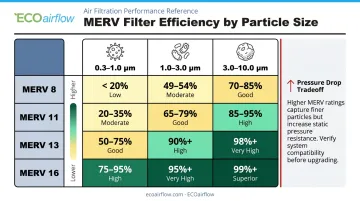
The tradeoff: denser media creates greater airflow resistance (pressure drop). A MERV 16 pleated filter can impose pressure drops of 0.6–1.2 in.w.g. — enough to force the blower to work harder, increase energy consumption, and accelerate wear.
UV-C Light Air Purifiers
Germicidal UV-C light (typically in the 200–280 nm band) inactivates airborne bacteria, viruses, and mold spores by disrupting their DNA. It doesn't trap particles — it neutralizes organic contaminants that pass through the irradiation zone.
Key limitations to understand:
- Single-pass exposure time in a duct is a fraction of a second, so effectiveness depends heavily on lamp output, duct geometry, and airflow velocity
- Fungal spores generally require higher UV doses than bacteria, so pathogen type affects real-world results
- UV bulbs need annual replacement to maintain effective output
- Best used alongside a particle-trapping filter, not as a standalone solution
Electronic and Polarized Media Air Purifiers
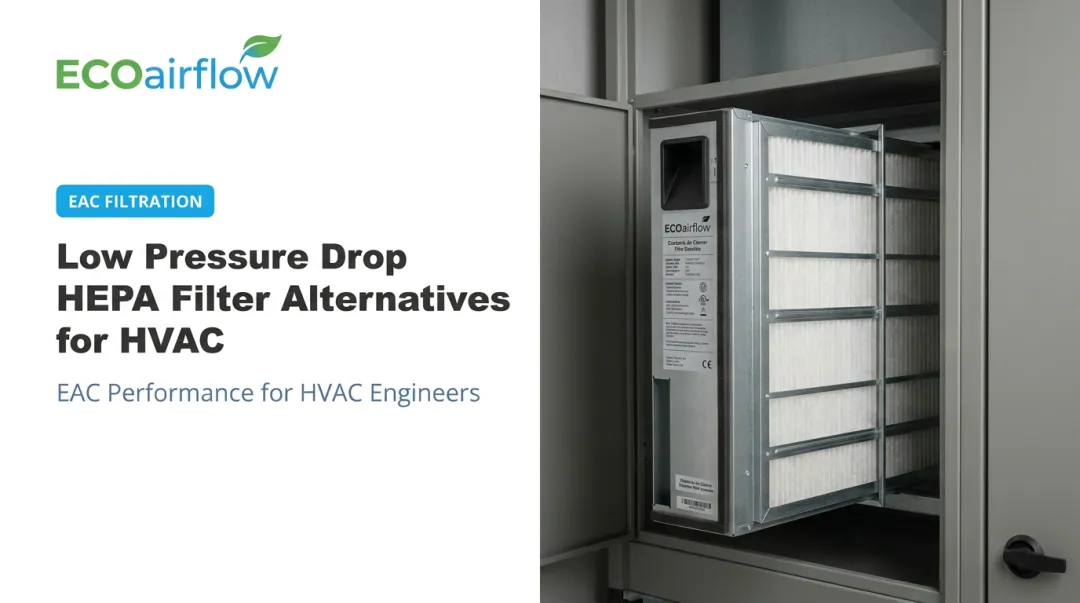
Electronic air purifiers use an electrical charge to attract particles to collection surfaces or media pads. Because particles are drawn to the media by electrostatic force rather than physically blocked by a tight fiber weave, these systems can achieve high capture efficiency with far lower air resistance.
ECOairflow's Electronic Polarization Technology (EPT) works through three simultaneous mechanisms:
- Collision — coarser particles are intercepted directly by the fiber media
- Polarization — a high-voltage field charges particles so they migrate toward oppositely charged pad fibers
- Agglomeration — charged particles attract each other, forming larger clusters that are easier to capture on subsequent passes
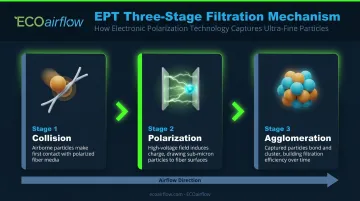
EPT-based units capture particles as small as 0.001 microns (including viruses, radon daughter progeny, and ultrafine combustion particles) while consuming 2 watts or less of power. All ECOairflow EPT models are UL2998 zero-ozone certified, confirmed at 0.0005 ppm — well below the 0.005 ppm regulatory threshold.
Independent testing found ECOairflow's commercial system captured 74.73% of PM0.1 ultrafine particles, compared to 49.19% for HEPA — making it approximately 50% more effective in that size range.
Activated Carbon Filters
Activated carbon works as a chemical adsorbent, trapping odor-causing molecules and VOCs that particle filters cannot capture — cooking smells, pet odors, chemical vapors from cleaning products and building materials.
Important caveats:
- Carbon capacity is finite; once saturated, it must be replaced or performance drops off
- Not all gases are adsorbed equally — effectiveness depends on contaminant chemistry, carbon mass, and airflow
- Carbon addresses gases and odors; it does not capture particles
For full-spectrum protection, carbon filtration needs to be paired with a particle-trapping system — which is where combination units come in.
Combination and Whole-Home Systems
Whole-home systems that combine technologies handle both particulate and chemical contaminants in a single pass. ECOairflow's residential and commercial lineup is built around this approach:
| Product | Technologies Combined | Contaminants Addressed |
|---|---|---|
| Model 1500 | Carbon filament + EPT | Viruses, bacteria, VOCs/formaldehyde, radon daughter progeny, wildfire smoke, allergens |
| M-Series™ 2" Hybrid | Passive MERV 8 mechanical + Powered EPT (MERV 14A/16A) | Airborne pathogens, coarse dust, wildfire smoke, tobacco smoke, formaldehyde, jet-fuel VOCs |
| Dynamo™ 1" | Collision + Polarization + Agglomeration (three-stage) | Particles to 0.001 microns, viruses, radon progeny, black carbon, allergens |
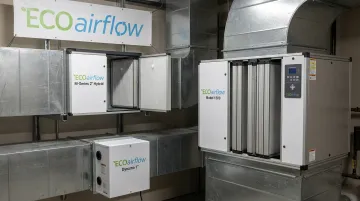
Whole-home systems installed in ductwork provide coverage for every room with a vent. Setting the HVAC fan to "On" rather than "Auto" maximizes air cycles through the purifier throughout the day.
How to Choose the Best Air Purifier for Your HVAC System
MERV Rating vs. Pressure Drop
Choosing the highest MERV rating available without checking system compatibility is one of the most common (and costly) mistakes buyers make.
A filter that's too dense for your system's blower forces higher energy consumption, reduces heating and cooling performance, and accelerates equipment wear.
The right choice depends on your system's external static pressure capacity and the filter's actual resistance at your system's face velocity.
This is where polarized media systems offer a practical advantage. ECOairflow's M-Series maintains MERV 13–16 performance at 0.13–0.37 in.w.g. pressure drop, compared to 0.6–1.2 in.w.g. for a conventional MERV 8 + MERV 14 bag filter hospital configuration. An independent 12-week study documented a 54% reduction in fan power consumption using the M-Series versus that conventional two-stage setup.
Before purchasing any high-MERV filter: have a qualified HVAC technician assess your system's airflow capacity. Mismatched filtration costs more to run and can damage the blower.
Once you know your system's limits, the next step is identifying which pollutants you actually need to capture — because not all particles are the same size, and not all technologies address the same range.
Particle Size and What You Need to Capture
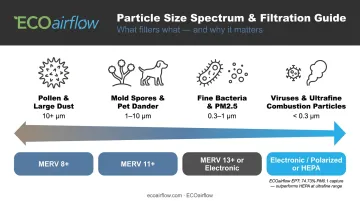
Different pollutants exist at different sizes — and different technologies address different ranges:
- Pollen, large dust (10+ µm) — captured by most MERV 8+ filters
- Mold spores, pet dander (1–10 µm) — MERV 11+ recommended
- Fine bacteria, fine PM (0.3–1 µm) — MERV 13+ or electronic systems
- Viruses, ultrafine combustion particles (below 0.3 µm) — requires electronic/polarized technology or HEPA
Your primary concern should drive your technology choice:
- Allergy sufferers → prioritize dander and pollen capture (MERV 11–13)
- Households near wildfire-prone areas or highways → ultrafine particle capture (electronic/polarized systems)
- Healthcare and commercial settings → pathogen control (MERV 14A–16A or HEPA-equivalent)
Ozone Safety and Zero-Ozone Certification
Some electronic air purifier technologies — particularly older ionizer designs — produce ozone as a byproduct. Ground-level ozone is a lung irritant. The CDC explicitly notes that ozone can worsen symptoms in people with asthma or COPD.
When evaluating any electronic air purifier:
- Look for UL2998 zero-ozone verification — this standard validates ozone emissions below 0.005 ppm (5 ppb), the most stringent threshold available
- Don't rely on manufacturer claims alone; require independent third-party confirmation
- The California Air Resources Board (CARB) and EPA both recommend UL2998-compliant systems for occupied spaces
ECOairflow's EPT-based systems are independently verified at 0.0005 ppm — one-tenth of the UL2998 limit — and meet ozone standards set by the FDA, NIOSH, CARB, EPA, and OSHA.
Maintenance and Long-Term Operating Costs
Purchase price is only part of the total cost of ownership. Factor in:
| System Type | Filter/Pad Replacement | Other Maintenance |
|---|---|---|
| Standard pleated | Every 1–3 months | None |
| High-MERV media | Every 3–6 months | None |
| UV-C | N/A for particles | Annual bulb replacement |
| Electronic (ECOairflow) | Every 3 months (residential), 3–6 months (commercial) | None beyond pad swap |
ECOairflow's permanent aluminum housing is a one-time capital purchase — only the glass-fiber pad is the only recurring cost. The pad swap is tool-free: open the housing, remove the old pad, drop in the new one.
Certifications and Safety Standards to Prioritize
Independent certifications verify what marketing language cannot. Here's what to look for — and what each certification actually confirms:
- ETL Listing (Intertek): Confirms the unit meets electrical safety standards from an OSHA-recognized testing lab. ETL alone does not verify filtration efficiency or ozone output.
- UL2998 Zero Ozone Verification: Confirms the system does not emit harmful ozone — validated at 0.005 ppm (5 ppb). Required by ASHRAE 62.1-2019 Section 5.7.1 for air-cleaning devices in occupied spaces, and recommended by both the CDC and EPA.
- MERV Certification under ASHRAE 52.2: True MERV testing uses ASHRAE certified dust with a carbon component, since real-world air contains organic and black carbon particles. Some manufacturers test with non-carbon substitute dust or test only while unpowered — neither produces a valid MERV rating. Ask whether the rating was achieved powered and with ASHRAE certified dust.
- ASHRAE 52.2 Appendix J (MERV-A): Tests filter performance in three states — powered, unpowered, and after conditioning that simulates real-world aging. A filter must hold its rated MERV performance across all three to earn the MERV-A designation. This is especially critical in hospitals, where performance must hold during power interruption.
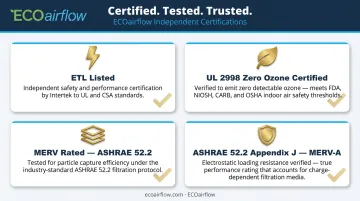
ECOairflow's M-Series holds ETL listing, UL2998 zero-ozone verification, and MERV 13A–16A certification under ASHRAE 52.2 with Appendix J. For commercial and healthcare settings, it also complies with ASHRAE 170 and CSA Z317.2 — and supports LEED EQ credit eligibility for green building projects.
Installation, Maintenance, and Costs
Installation and Maintenance
Installation
Whole-home HVAC air purifiers install in the ductwork near the air handler. For ECOairflow's electronic systems, setup involves positioning the unit in the existing filter slot and connecting to the air handler's standard 24V power source.
For homes with existing 4" or 5" filter cabinets from legacy systems (Honeywell F300, AprilAire 5000, Lennox PureAir, Trane CleanEffects, Carrier Infinity), ECOairflow's Cabinet Conversion Kit offers a tool-free retrofit using neodymium magnetic rails — no drilling, no cabinet modification.
Professional installation is strongly recommended for all HVAC-integrated systems:
- Correct sizing prevents both undersizing (insufficient filtration) and oversizing (excessive pressure drop)
- A qualified technician can assess your system's static pressure capacity before selecting a MERV level
- The 24V electrical connection requires an HVAC-trained technician familiar with low-voltage wiring
ECOairflow installs through authorized HVAC contractors across North America. Contractor referrals and installation documentation are available by calling 1-877-347-3569.
Maintenance
Pad replacement follows a simple schedule:
- Residential models (Dynamo 1", Model 1000, Model 1500): Replace the glass-fiber pad every 3 months
- Commercial models (Model 2300, M-Series): Replace every 3–6 months depending on facility load
The process is tool-free — open the housing, swap the pad, close it. No service call required. The Dynamo 1" features hermetically sealed electronics that block moisture and particulate damage, backing the model's lifetime electronics warranty.
ECOairflow offers a free email reminder service and direct-ship pad subscriptions at ecoairflow.com to simplify the replacement cycle. Together, straightforward installation and minimal upkeep make these systems a practical long-term investment for both residential and commercial applications.
Frequently Asked Questions
Can you install an air purifier on your HVAC system?
Yes. Whole-home air purifiers install directly into existing ductwork, typically near the air handler, by a qualified HVAC technician. Once installed, they filter all air circulating through the system — covering every room connected to a vent.
Are air purifiers for HVAC systems worth it?
For most households and commercial spaces, yes. They reduce allergens, capture pathogens, protect HVAC equipment from particulate buildup, and lower energy costs through reduced pressure drop — benefits that add up well beyond the upfront price.
Would an HVAC air purifier help with COPD?
An HVAC air purifier can reduce exposure to fine particles, mold spores, VOCs, and smoke — irritants that commonly trigger or worsen COPD symptoms. Consult your physician about your specific situation, and look specifically for systems certified zero-ozone, since ozone itself is a respiratory irritant.
Will an HVAC air purifier help with post-nasal drip?
If post-nasal drip is triggered by airborne allergens — dust, pollen, mold, or pet dander — an HVAC air purifier that captures those particles can meaningfully reduce symptom frequency. Results depend on the underlying cause; non-allergic post-nasal drip may not respond to air filtration.
What is the difference between a standard HVAC filter and an HVAC air purifier?
A standard filter (typically 1-inch, low MERV) is designed to protect HVAC equipment from large debris, not to improve air quality for occupants. A whole-home air purifier is built to capture microscopic particles, pathogens, and gases that standard filters let pass through freely.
What MERV rating should I look for in an HVAC air purifier?
MERV 13–16 is generally recommended for meaningful health-focused filtration. The right rating depends on your system's airflow capacity — too high a MERV for a given system creates pressure drop that reduces efficiency and risks equipment damage. Professional assessment before purchase is essential.