Introduction
Students in U.S. public schools spend an average of 6.64 hours per day across 180 school days per year — that's roughly 1,200 hours annually inside school buildings. Yet despite this enormous time commitment, indoor air quality in those spaces rarely gets the same public attention as outdoor pollution.
The gap is worth closing. According to the EPA, indoor pollutant levels can be 2 to 5 times higher than outdoor levels — and sometimes more than 100 times higher.
Nearly 46% of U.S. schools have reported at least one environmental problem tied to indoor air quality. That's a mainstream public health problem reaching tens of millions of students every school day.
What follows gives school administrators and facility managers a grounded look at why school buildings are uniquely high-risk environments, which pollutants show up most often, how poor air quality affects student health and academic performance, and what schools can realistically do about it: filtration upgrades, monitoring programs, and funding sources.
Key Takeaways
- Poor school IAQ is directly linked to worsened asthma, increased absences, headaches, and long-term respiratory harm in children
- Children are more vulnerable than adults, breathing more air per body weight while their organs are still developing
- CO2 buildup, mold, dust mites, VOCs, wildfire smoke, and diesel exhaust are the most common school pollutants
- Ventilation upgrades and MERV 13+ filtration are among the most effective interventions available to schools
- Federal funding through ESSER and DOE programs can offset HVAC and filtration upgrade costs
Why Schools Are High-Risk Indoor Environments
Schools combine several conditions that make poor air quality almost inevitable without active management.
The Building Problem
A 2020 GAO report found that 41% of school districts needed HVAC updates or replacement in at least half their schools — affecting roughly 36,000 schools nationwide. A separate NCES survey found that 30% of permanent public school buildings rated their heating, ventilation, and air conditioning systems as fair or poor.
High occupancy density compounds the infrastructure gap. Nearly 56 million people — about 20% of the U.S. population — spend their days inside elementary and secondary schools. When aging ventilation systems can't handle that load, pollutants accumulate fast.
Why Children Are More Vulnerable
Children are not simply smaller adults when it comes to air pollution exposure:
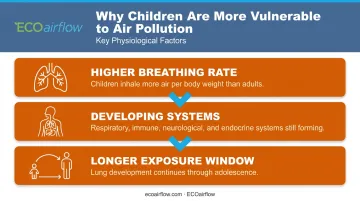
- They breathe more air per unit of body weight than adults, increasing their dose of any given pollutant
- Their respiratory, immune, neurological, and endocrine systems are still developing — making early, repeated exposure more consequential
- Lung development continues through adolescence, meaning damage from chronic low-level exposure can have lasting effects
The Equity Dimension
Not all schools face equal exposure. Environmental health research has found that schools serving higher percentages of Black, Hispanic, multi-ethnic, and subsidized-meal-eligible students face consistently greater exposure to road-traffic PM2.5. Schools in low-income communities are disproportionately located near high-traffic roads and industrial areas. That proximity compounds the indoor air quality problem with elevated outdoor pollutant pressure that better-resourced schools rarely face.
What's Polluting the Air Inside School Buildings
School air quality problems come from two directions: pollutants generated inside the building, and outdoor pollution that gets drawn in.
Indoor-Generated Pollutants
CO2 from occupants is one of the most pervasive and overlooked problems. A Boston Public Schools study found that classroom CO2 exceeded 1,000 ppm for 24% of school hours on average (the common ventilation screening benchmark) and exceeded 2,000 ppm for 2% of hours. Elevated CO2 causes fatigue, reduced concentration, and measurable cognitive decline. Separately, a study of 100 fifth-grade classrooms found that 87 out of 100 had ventilation rates below the 15 cfm/person guideline used in the research.
Biological contaminants show up repeatedly in older buildings:
- Mold from water damage and deferred maintenance
- Dust mite allergens in carpets and upholstered furniture
- Cockroach and rodent allergens in buildings with pest issues
All are directly tied to asthma triggers — and asthma is one of the leading drivers of school absences.
VOCs (volatile organic compounds) off-gas continuously from synthetic carpets, vinyl tiles, adhesives, paints, and the scented cleaning products used in daily school operations. The EPA's school IAQ reference guide specifically identifies cleaning materials, chalk, and dry-erase markers as VOC sources — all standard in virtually every classroom.
Pollutants That Enter from Outside
Two outdoor sources consistently drive indoor pollution spikes in schools:
- Diesel exhaust from school buses — A study of 74 urban schools found that classrooms facing bus drop-off areas had measurably higher indoor PM2.5, black carbon, and nitrogen dioxide. The EPA notes that exhaust from idling buses enters buildings through air intakes, doors, and open windows, making no-idling policies and filter quality both critical.
- Wildfire smoke — Carries fine particulate matter (PM2.5) and ultra-fine particles (PM0.1) including black carbon, carbon monoxide, and nitrogen dioxide that penetrate buildings through aging envelopes and inadequate filtration.
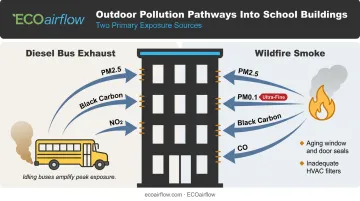
HVAC systems with undersized or aging filters don't just fail to block these pollutants — in some configurations, they actively pull outdoor air in without any meaningful filtration at all.
How Poor Air Quality Affects Student Health
Short-Term Symptoms
Students and staff in poorly ventilated schools commonly experience headaches, eye and throat irritation, nasal congestion, fatigue, dizziness, and shortness of breath. These symptoms are frequently attributed to other causes (a cold, allergies, stress), which delays meaningful action on the underlying air quality problem.
Asthma: The Leading IAQ Health Concern
According to the CDC, approximately 1 in 13 school-age children have asthma, and asthma is one of the leading causes of school absenteeism. In 2013 alone, children aged 5–17 with asthma missed 13.8 million school days, with nearly half missing at least one school day due to their condition.
Indoor allergens (dust mites, mold, pest allergens) and chemical irritants directly trigger or worsen asthma attacks. Schools with biological contamination and poor filtration are, in effect, asthma-triggering environments that children are required by law to enter.
The Risk from Fine and Ultra-Fine Particles
PM2.5 particles penetrate deep into the lungs. Ultra-fine particles (PM0.1) go further — they travel from the lungs into the bloodstream, reaching the heart, liver, and brain. Research links ultrafine particle exposure to oxidative stress, systemic inflammation, and cardiovascular and pulmonary effects.
Yet the filters in most school HVAC systems offer little protection against these risks. Standard MERV 8 filters capture virtually none of these particles — wildfire smoke, diesel exhaust, and viral aerosols all fall below what passive pleated filters can reliably intercept.
Compounded Risk for Vulnerable Students
Students with pre-existing asthma, allergies, chemical sensitivities, or suppressed immune systems face a compounding problem. For these students, poor IAQ moves beyond occasional discomfort. Manageable chronic conditions can escalate into recurring health crises, leading to more medication, emergency visits, and extended absences.
The Connection Between Air Quality and Academic Performance
Poor air quality doesn't just make students sick. It makes it harder to learn.
Ventilation, CO2, and Cognitive Performance
Research synthesized in Harvard T.H. Chan School of Public Health's Schools for Health report documents that poor CO2 and ventilation conditions are associated with fatigue, impaired attention, and poorer student performance. A separate study by Bakó-Biró et al. found that low classroom ventilation rates significantly reduced pupils' attention and vigilance.
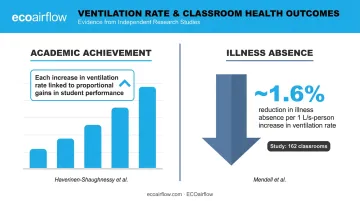
Haverinen-Shaughnessy et al. identified a linear association between classroom ventilation rates and academic achievement across a range of ventilation rates — meaning improvements in ventilation produced measurable, proportional gains in student performance.
The Absence-Achievement Chain
Poor IAQ increases illness rates, which drives absences and erodes instructional time — a direct path to lower academic and social-emotional outcomes.
Mendell et al., studying 162 classrooms in 28 California elementary schools, found that each 1 L/s-person increase in ventilation rate was associated with approximately 1.6% lower illness absence — a measurable, repeatable relationship documented across hundreds of real classrooms.
Teachers Are Affected Too
Research by Ervasti et al. found that good and improved school IAQ was associated with decreased teacher sick leave. Teachers experiencing fatigue, headaches, or illness due to poor IAQ are less effective in the classroom. The compounding effect touches every layer of the school day:
- More student illness and absences
- Reduced instructional effectiveness from affected teachers
- Higher absenteeism on both sides of the desk
How Schools Can Improve Indoor Air Quality
Assess Before Acting
Schools that act without data often invest in the wrong areas. Real-time monitoring — CO2 sensors, particulate monitors, and humidity tracking — helps identify exactly where and when air quality problems occur.
Boston Public Schools provides a useful model. BPS launched a district-wide IAQ monitoring program with a publicly available sensor dashboard. Their data showed CO2 exceeded 1,000 ppm for 24% of school hours across the district — a finding that directly informed ventilation improvement priorities. That kind of data-driven approach turns IAQ management from reactive to systematic.
Upgrade Ventilation and Filtration
Ventilation is the foundation. Many school HVAC systems are outdated, improperly maintained, or both. Regular inspection, filter changes, and damper adjustments are minimum steps. Where systems fail to deliver adequate fresh air, mechanical upgrades may be necessary.
Filtration grade is just as consequential. Both the EPA and CDC recommend increasing HVAC filtration to MERV 13 or higher where systems can support it. Standard MERV 8 filters — the most common grade in school buildings — offer almost no protection against fine particles, allergens, or viral aerosols.
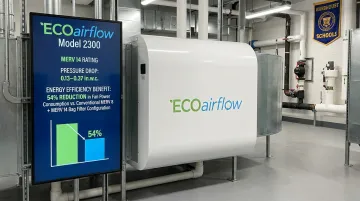
ECOairflow's commercial products are built for school HVAC applications where higher filtration grades and energy constraints both matter. The Model 2300 operates at MERV 14 with a pressure drop of just 0.13–0.37 in.w.c. — roughly 3 to 8 times lower than a conventional MERV 8 + MERV 14 bag filter configuration.
For schools with aging fan systems that can't support the resistance of high-MERV passive filters, that pressure difference is significant. Independent testing documented a 54% reduction in fan power consumption over 12 weeks compared to the traditional two-stage filter bank.
For higher-acuity school spaces (nurse stations, special-needs classrooms, athletic facilities), the M-Series Hybrid (MERV 13–16A, Appendix J certified) maintains full rated performance whether powered or unpowered, ensuring continuous protection even during power interruptions.
Both products carry UL 2998 Zero Ozone Verification, which is mandatory under ASHRAE 62.1 for occupied buildings and specifically critical in classrooms where children with developing respiratory systems spend hours each day.
Portable HEPA air purifiers serve as a practical interim option in classrooms where central HVAC upgrades aren't immediately feasible. Following Los Angeles wildfires, LAUSD received 580 air purifiers to supplement classroom air quality — a practical stopgap while longer-term solutions are developed.
Control Pollution at the Source
Filtration improvements work best alongside source reduction:
- Switch to low-VOC cleaning products and eliminate scented aerosols inside buildings
- Select low-emission building and furnishing materials for renovations
- Enforce no-idling zones for buses and parent vehicles near school entrances
- Address water damage and mold through prompt maintenance rather than deferred repair
Access Available Funding
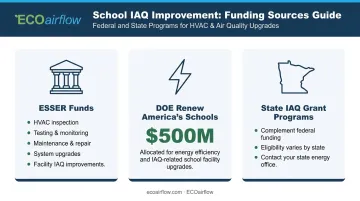
Schools don't need to fund IAQ improvements entirely from operating budgets. Federal programs are available:
- ESSER funds can be used for HVAC inspection, testing, maintenance, repair, and upgrades
- The DOE Renew America's Schools program allocated $500 million for energy improvements at public school facilities, including IAQ-related upgrades
- State IAQ improvement grant programs complement federal funding in many states
ECOairflow supports school district procurement through these channels and provides ASHRAE compliance documentation, Appendix J certification data, and PM0.1 lab-test reports on request. These are the materials specifying engineers and procurement officers typically require for bid specifications. Contact the team at 1-877-347-3569 or sales@ecoairflow.com.
Frequently Asked Questions
Why is air quality important in schools?
Students spend roughly 1,200 hours per year inside school buildings where indoor pollutant levels can be 2 to 5 times higher than outdoors. Poor IAQ directly affects student health, drives absences, and impairs the cognitive performance needed for learning.
What health problems can poor air quality in schools cause?
Short-term effects include headaches, eye irritation, and fatigue. Longer term, repeated exposure worsens asthma and allergies, and can harm the developing respiratory and immune systems of children whose organs are still forming.
At what AQI level should students stay inside at school?
When the outdoor AQI exceeds 100 (Unhealthy for Sensitive Groups), schools should limit outdoor activity. Staying inside only helps if the indoor environment has adequate filtration. Poor indoor air quality can make sheltering in place counterproductive.
What are the most common indoor air pollutants found in schools?
Common culprits include:
- CO2 from classroom occupants
- Mold spores and dust mite or pest allergens
- VOCs from building materials and cleaning products
- Fine particles from wildfire smoke and diesel exhaust from idling school buses
How can schools improve indoor air quality on a budget?
Practical starting points include:
- Upgrade HVAC filters to MERV 13 or higher
- Install CO2 monitors to identify problem classrooms
- Use portable air cleaners as an interim measure
- Switch to low-VOC cleaning products
- Establish no-idling zones near building entrances
What MERV rating should school air filters have?
The EPA, CDC, and ASHRAE recommend at least MERV 13 for school environments. This rating captures fine particles, allergens, and most airborne pathogens. Higher-rated systems — MERV 14 or above — offer greater protection, particularly for students with asthma or chronic respiratory conditions.