Introduction
Most homeowners who test for radon focus on the gas itself — but the gas is only half the story. The real biological threat comes from what radon becomes after it enters your home.
When radon-222 decays, it produces short-lived radioactive isotopes called radon daughters (or radon progeny). Unlike radon gas — which is mostly exhaled before it can cause damage — these decay products are solid, electrically charged particles that cling to dust, surfaces, and lung tissue.
Once inhaled, they emit alpha radiation directly into the sensitive cells lining your airways. That localized exposure is what drives radon's cancer risk.
According to the EPA, radon causes approximately 21,000 lung cancer deaths in the United States every year — including roughly 2,900 among people who never smoked. Health Canada puts the Canadian figure at 3,200 deaths annually.
Understanding radon daughters — not just radon gas — is what determines whether your mitigation strategy actually protects you.
Key Takeaways
- Radon daughters are solid, electrically charged radioactive particles — not gases — that readily attach to airborne dust and lung tissue
- Unlike radon gas, which is mostly exhaled, radon daughters lodge in lung airways and emit alpha radiation directly into bronchial tissue
- Long-term exposure is the leading environmental cause of lung cancer among non-smokers in North America
- Effective exposure reduction starts with testing, then structural mitigation — with air filtration as an added line of defense
What Are Radon Daughters?
The Decay Chain
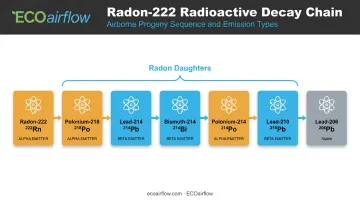
Radon-222 is a radioactive noble gas produced naturally from uranium in soil and rock. When it decays, it doesn't simply disappear — it transforms into a sequence of shorter-lived radioactive isotopes:
Polonium-218 → Lead-214 → Bismuth-214 → Polonium-214 → Lead-210 → (longer tail) → Lead-206 (stable)
This sequence — polonium-218, lead-214, bismuth-214, and polonium-214 — is what scientists call radon daughters, radon progeny, or radon decay products (RDP). "Radon daughters" is the older term common in health literature; "radon progeny" is the preferred modern scientific label.
Gas vs. Solid: A Critical Difference
Radon gas is chemically inert. It doesn't bond with anything and passes through your lungs before it can decay. Radon daughters behave differently. They're solid, electrically charged particles the moment they form, and they aggressively attach to:
- Airborne dust and aerosols
- Skin and clothing
- The mucous membranes and tissue lining your lungs
This physical difference is what makes the daughters so much more dangerous than the gas that produced them.
Equilibrium Factor and Measurement Units
Because daughters are solid and charged — unlike the gas that created them — they accumulate in enclosed indoor spaces rather than dispersing. The EPA uses a standard indoor equilibrium factor of 0.4 (40%), meaning daughter activity in a typical home reaches about 40% of what it would be at full equilibrium with radon. In poorly ventilated spaces, that buildup rises further.
Two measurement systems apply here:
| What's Being Measured | Unit | Context |
|---|---|---|
| Radon gas concentration | pCi/L (or Bq/m³ in Canada) | Consumer testing, action levels |
| Radon daughter concentration | Working Level (WL) | Technical/occupational dosimetry |
| Cumulative daughter exposure | Working Level Months (WLM) | Long-term dose history |
Understanding the distinction matters because the health risk comes from the daughters, but radon gas testing is the practical proxy used in homes — so a high radon reading is a reliable signal that daughter concentrations are also elevated.
Why Radon Daughters Are More Dangerous Than Radon Gas
The Inhalation Pathway
When you breathe air containing radon daughters — whether they're attached to dust particles or floating free — those particles deposit in your airways. Radon gas, by contrast, is mostly exhaled before it decays inside the body.
The daughters' short half-lives change everything:
- Polonium-218: ~3 minutes
- Lead-214: ~27 minutes
- Bismuth-214: ~20 minutes
- Polonium-214: less than 1 millisecond
These half-lives are short enough that the daughters decay while still lodged in bronchial tissue — emitting radiation directly into sensitive lung cells rather than in open air.
Alpha Radiation Inside the Lung
Polonium-218 and polonium-214 are the most hazardous daughters. Both emit high-energy alpha particles as they decay. Alpha particles can't penetrate skin (a sheet of paper stops them), so external exposure isn't the concern.
Inside the lung, that changes completely. At close range within bronchial tissue, alpha particles deliver intense ionizing radiation directly to the epithelial cells lining your airways — causing DNA strand breaks and mutations that can lead to cancer over time.
Attached vs. Unattached Daughters
Not all radon daughters behave the same way once airborne:
- Unattached daughters (free, not yet bound to a dust particle) penetrate deeper into the lung and are considered more biologically hazardous
- Attached daughters (bound to larger aerosol particles) deposit higher in the airways and are somewhat less likely to reach the deepest lung tissue
Indoor conditions — humidity, dust levels, ventilation rate — all shift the balance between these two fractions. Higher dust concentrations mean more attached daughters; better ventilation reduces overall concentrations of both.
IARC Classification and No Safe Level
IARC Monograph Volume 100D classifies radon-222 and its decay products as Group 1 human carcinogens — meaning sufficient evidence of causation in humans, not just statistical association. This is the highest classification IARC assigns.
The EPA is direct on this point: there is no known safe level of radon exposure. Daughters accumulate indoors, and health impact is driven by cumulative lifetime dose — which means years of exposure at seemingly moderate levels can still produce significant lung cancer risk. The EPA's action level of 4 pCi/L is a mitigation threshold, not a safety guarantee.
How Radon Daughters Affect Your Health
Lung Cancer: The Primary Risk
Radon daughters are the second leading cause of lung cancer in the United States and the leading environmental cause among non-smokers. The numbers are stark:
- ~21,000 U.S. lung cancer deaths per year attributed to radon
- ~3,200 Canadian lung cancer deaths per year attributed to radon
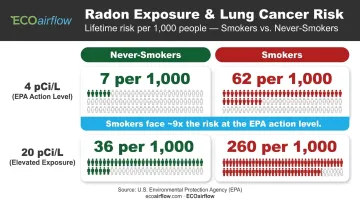
- At 4 pCi/L, the EPA estimates 7 per 1,000 never-smokers will develop lung cancer from lifetime exposure
The Smoking Multiplier
If you smoke and live in a high-radon home, the risk is not simply additive — it's synergistic. The EPA's risk table illustrates this sharply:
| Exposure Level | Never-Smokers | Smokers |
|---|---|---|
| 4 pCi/L (EPA action level) | 7 per 1,000 | 62 per 1,000 |
| 20 pCi/L (elevated) | 36 per 1,000 | 260 per 1,000 |
A smoker at 4 pCi/L faces nearly nine times the risk of a non-smoker at the same level. The two exposures amplify each other through compounding biological damage.
Silent Damage, Late Symptoms
Radon daughters don't cause immediate symptoms. The damage is cumulative — building silently over years or decades. By the time signs appear (persistent cough, shortness of breath, chest discomfort), lung disease is often advanced. That long latency period leaves no early warning system. Testing is the only way to know your exposure level before damage accumulates.
Other Potential Health Effects
Lung cancer is the firmly established health outcome from radon daughter exposure. Beyond that, the BEIR VI report and WHO have explored possible links to leukemia and other cancers — but no other cancer risks have been established based on current evidence. These remain areas of ongoing research, not confirmed health effects.
Who Faces Higher Risk
- Basement and lower-level occupants — where radon and daughter concentrations are highest
- Non-smokers who may assume they face no lung cancer risk from environmental exposures
- Occupants of poorly ventilated homes — tighter buildings accumulate higher daughter concentrations
- Residents in high-radon geographies — parts of Iowa, Pennsylvania, Manitoba, New Brunswick, and the Yukon face statistically elevated radon levels
Where Radon Daughters Build Up in Your Home
Entry Points and Concentration Zones
Radon enters buildings from soil and rock through:
- Foundation cracks and construction joints
- Sump pits and floor drains
- Gaps around utility pipes
Because radon is denser than air, it accumulates in basements, crawlspaces, and lower building levels. Since daughters form wherever radon is present, these areas carry the highest daughter concentrations — and represent the highest exposure risk for anyone in those spaces.
Indoor Conditions That Worsen Buildup
Several factors amplify radon daughter accumulation:
- Low ventilation and air exchange: without fresh air turnover, daughter concentrations climb steadily toward the radon source's output rate
- High dust and particulate levels — daughters attach to airborne dust particles, keeping radioactive complexes suspended and inhalable rather than plating out harmlessly on floors
- Restricted airflow zones: utility rooms, storage areas, and finished basements with limited circulation
These conditions are more common than most homeowners expect. Nearly 1 in 15 U.S. homes has elevated radon levels, according to the EPA. Health Canada's Cross-Canada Survey found 6.9% of Canadian homes exceed the national guideline of 200 Bq/m³ — with Manitoba (19.4%), New Brunswick (18.7%), and Yukon (19.6%) seeing significantly higher rates.
Home Types at Elevated Risk
- Homes built on granite, shale, or uranium-rich soils
- Homes with basements or crawlspaces in direct contact with soil
- Older homes with compromised foundation integrity
- Homes in EPA Radon Zone 1 geographic regions
Testing and Reducing Your Exposure to Radon Daughters
Testing First — Always
Radon daughters are invisible, odorless, and tasteless. Testing is the only way to know your risk level.
- Short-term tests (48 hours to 90 days): Good for initial screening; quick results
- Long-term tests (90+ days): More accurate for true average annual exposure
The EPA recommends testing on the lowest livable floor of every home. Action levels to know:
- EPA action level: 4 pCi/L — fix the home at or above this level
- Consider action: 2–4 pCi/L — no safe level exists, so mitigation is worth evaluating
- Health Canada guideline: 200 Bq/m³ — corrective action recommended within one year
Structural Mitigation: Address the Source
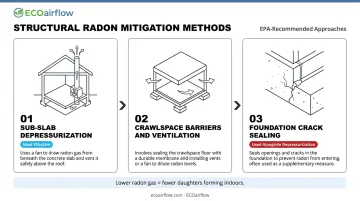
When testing reveals elevated radon, structural mitigation targets the gas at its entry point, which in turn reduces daughter formation indoors. Primary approaches include:
- Sub-slab depressurization — the most effective method; a vent pipe and fan draw radon from beneath the foundation and exhaust it above the roofline before it enters living spaces
- Crawlspace barriers and ventilation — reduces soil gas infiltration and dilutes radon concentration
- Foundation crack sealing — limits entry points, typically used alongside depressurization systems
These methods address the radon source directly. Lower radon gas means fewer daughters forming in your indoor air.
Air Filtration as a Complementary Layer
Because radon daughters are solid particles that attach to airborne dust, high-performance air filtration can substantially reduce the concentration of daughter-laden particles in indoor air — even when structural mitigation is already in place.
Standard pleated filters — even MERV 13 — cannot capture RDP particles. Unattached radon daughters form at sub-nanometer scale, well below the 0.3-micron threshold of passive mechanical filtration.
ECOairflow's residential lineup uses patented Electronic Polarization Technology (EPT) to capture particles through electrostatic attraction rather than mechanical interception:
- Dynamo™ 1" E.A.C. — MERV 12 rated; lifetime warranty on electronics
- Model 1500 — MERV 12 rated; captures down to 0.007 microns; 5-year warranty
- Model 1000 — MERV 11 rated; captures down to 0.001 microns; 5-year warranty
Because freshly formed radon daughters carry an electrical charge as a byproduct of radioactive decay, EPT's polarized field is particularly effective at pulling unattached RDP out of the airstream.
Independent third-party testing confirmed that ECOairflow units reduced RDP to levels below WHO-recommended thresholds. Testing followed National Radon Proficiency Program protocols and US EPA guidelines, conducted by certified radon professionals.
ECOairflow filters capture airborne RDP particles — they do not remove radon gas itself. Active Soil Depressurization (ASD) remains the EPA gold standard for addressing radon at the source. ECOairflow works alongside ASD or, where structural mitigation isn't feasible, as a standalone airborne option. A certified radon professional should assess your situation before any strategy is finalized.
Frequently Asked Questions
What are radon daughters?
Radon daughters (also called radon progeny) are short-lived radioactive isotopes produced when radon-222 decays. These solid, charged particles — polonium-218, lead-214, bismuth-214, and polonium-214 — cling to dust and lung tissue, making them the direct cause of radiation damage in the respiratory tract.
What is the half-life of radon daughters?
Half-lives are brief: polonium-218 (~3 min), lead-214 (~27 min), bismuth-214 (~20 min), and polonium-214 (<1 millisecond). Each decays far faster than radon gas (3.8-day half-life), emitting radiation directly into lung tissue before the body can clear them.
What types of homes are more likely to have radon?
Homes on uranium- or radium-rich soils (granite, shale), with basements or crawlspaces in direct soil contact, or in poorly ventilated high-radon regions carry the greatest risk. That said, any home can have elevated levels — testing is the only way to know for certain.
What are the first signs of radon exposure?
There are typically none. Radon daughter exposure causes no immediate symptoms; health damage accumulates silently over years. A persistent cough, shortness of breath, or chest discomfort — when they do appear — may indicate advanced lung disease. Regular testing is the only reliable early warning.
Are radon daughters more dangerous than radon itself?
Yes. Radon gas is mostly exhaled before it decays in the body. Radon daughters are solid particles that deposit in the lungs and emit alpha radiation directly into bronchial tissue — that's the actual mechanism behind radon-linked lung cancer. The gas delivers them there; the daughters do the damage.
Can air filtration help reduce radon daughter exposure?
It can, because radon daughters attach to airborne particles that high-efficiency filtration systems can capture. However, filtration addresses the airborne daughter particles — not radon gas itself. It works best as a complement to structural mitigation like sub-slab depressurization, not as a replacement for it.