What is an electronic air cleaner with eHEPA and how does it differ from a standard HEPA filter?
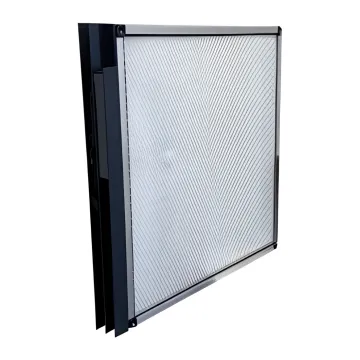
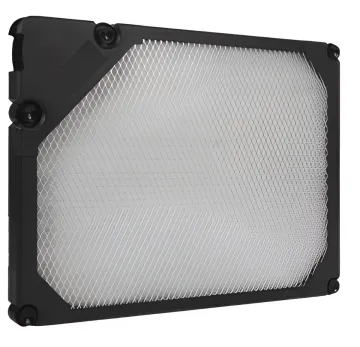
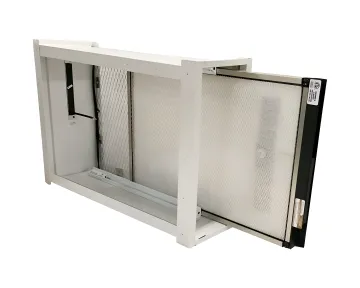
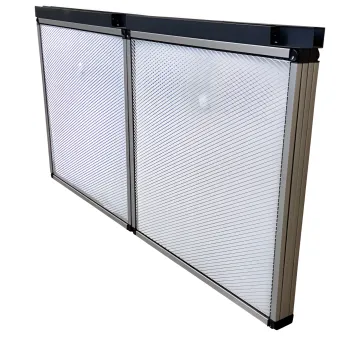
An electronic air cleaner with eHEPA uses Electronic Polarization Technology (EPT) to create a polarized electromagnetic field across a glass-fiber mesh, attracting particles as small as 0.001 microns. Unlike passive HEPA filters — which rely solely on mechanical blocking — ECOairflow eHEPA units are lab-tested to capture PM0.1 ultra-fine particles at 74.73% efficiency, outperforming HEPA's 49.19% under identical conditions.
Are ECOairflow electronic air cleaners safe for occupied spaces and do they produce ozone?
Yes. All ECOairflow electronic air cleaners are certified by Intertek ETL to UL 2998 Zero Ozone Verification standards, emitting below 0.0005 ppm of ozone — well under FDA, EPA, NIOSH, CARB, and OSHA limits. They are explicitly recommended by the US CDC and US EPA for safe use in occupied residences, schools, offices, and hospital environments including operating rooms.
What MERV ratings are available and which model is right for my application?
ECOairflow offers MERV 11 (Model 1000, residential budget), MERV 12 (Model 1500 and Dynamo 1", residential premium), MERV 14 powered (Dynamo 2" Model 2300, commercial), and MERV 13–16A (M-Series Hybrid, hospital-grade ASHRAE 170 compliant). Residential applications typically suit MERV 11–12; commercial buildings MERV 14; hospitals and healthcare facilities the M-Series MERV 14A or 16A.
How much energy can I save by switching from disposable pleated filters to an ECOairflow electronic air cleaner?
ECOairflow's low-pressure-drop design (as low as 0.09 in.w.c.) can reduce annual HVAC heating and cooling costs by up to 15% versus conventional disposable pleated filters. An independent hospital study documented a 54% reduction in fan power consumption over 12 weeks versus a standard MERV 8 + MERV 14 bag filter train.
How often do the replacement pads need to be changed and how difficult is maintenance?
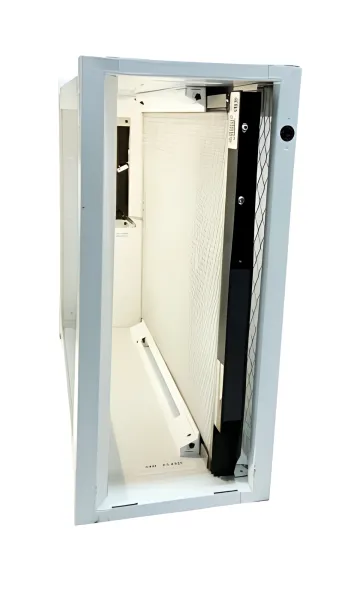
ECOairflow recommends replacing pads every 3 months for residential units. Maintenance requires no tools — simply open the filter housing, remove the old pad, and drop in a new one. Commercial pad intervals extend to 3–6 months depending on load. An optional email reminder service is available at ecoairflow.com/email-reminders to simplify scheduling.
Can ECOairflow filters help with wildfire smoke, radon daughter progeny, and virus capture?
Yes. ECOairflow's EPT captures black and organic carbon particles from wildfire smoke, ultra-fine PM0.1 particles associated with airborne viruses and bacteria, and radon daughter progeny (RDP) — the radioactive decay particles that drive long-term radon-related lung-cancer risk. Note: ECOairflow's RDP filtration complements but does not replace active soil depressurization (ASD) systems for radon gas itself.
Are ECOairflow commercial filters compliant with ASHRAE, LEED, and hospital standards?
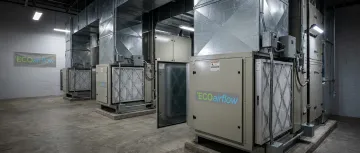
Yes. The Dynamo 2" Model 2300 and M-Series Hybrid comply with ASHRAE 62.1 (2022), 90.1, and 241 (2023). The M-Series MERV 14A and 16A pads meet ASHRAE 170 and CSA Z317.2 for hospital operating rooms and treatment areas. All commercial products qualify for LEED EQ credits, WELL Building Standard, ILFI, NGBS, and Passivehaus credits.
What industries and building types are ECOairflow ceiling-mount electronic air cleaners designed to serve?
ECOairflow ceiling-mount electronic air cleaners are designed for a wide range of applications, including residential homes (whole-home HVAC filtration for allergens, viruses, and radon progeny), healthcare and hospitals (ASHRAE 170-compliant MERV 14A–16A for operating rooms and ERs), commercial buildings and schools (MERV 14 low-pressure-drop filtration meeting ASHRAE 62.1 and LEED EQ standards), and industrial and government facilities (high-face-velocity units for airports and federal buildings requiring ASHRAE 90.1 compliance).