The problem is that most homeowners either grab whatever fits or pick by price. Neither approach works well for allergy relief. Fiber type, filtration rating, and filter thickness all determine whether your filter actually traps pollen, pet dander, and dust mite fragments — or just lets them recirculate.
This guide compares five of the top allergy-focused AC filters on the market, from widely available 1-inch pleated options to advanced powered electronic systems, so you can match the right filter to your symptoms, system, and budget.
Key Takeaways
- MERV 13 or higher captures nearly all common allergens — it's the recommended starting point for most allergy sufferers
- Electronic air cleaners outperform both pleated and fiberglass filters for ultrafine particle capture — the size range where allergens do the most damage
- Thicker 4–5 inch media filters capture more and need replacement less often than standard 1-inch options
- Even the best filter fails if it's the wrong size, poorly seated, or not changed on schedule
- Match filter type to your specific allergens and HVAC setup — performance on paper only matters if the filter fits your system
Why Your AC Filter Is Your Home's Best Allergy Defense
Allergens don't stay where they land. Pollen tracked in from outside, pet dander shed on the couch, and dust mite fragments all become airborne the moment someone walks through a room.
Your HVAC system then pulls that air through every room in the house. Without proper filtration, contaminated air handler systems can harbor mold and biological contaminants and spread them throughout your living space, according to EPA guidance on biological pollutants.
Understanding MERV Ratings
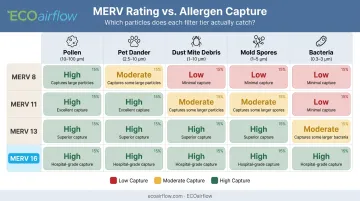
MERV — Minimum Efficiency Reporting Value — was developed by ASHRAE under Standard 52.2. It measures a filter's efficiency at capturing particles across three size ranges:
| MERV Rating | 0.3–1.0 µm (E1) | 1.0–3.0 µm (E2) | 3.0–10.0 µm (E3) |
|---|---|---|---|
| MERV 8 | No minimum | ≥20% | ≥70% |
| MERV 11 | ≥20% | ≥65% | ≥85% |
| MERV 13 | ≥50% | ≥85% | ≥90% |
| MERV 16 | ≥95% | ≥95% | ≥95% |
Most common allergens — pollen, pet dander, dust mite debris — fall in the 1–10 micron range, which MERV 11 and above handle well. Mold spores and some bacteria sit closer to 1–3 microns, where MERV 13 captures a significantly higher share of those particles.
MPR and FPR: Proprietary Scales Explained
Not all filters use MERV. Two proprietary systems you'll encounter:
- MPR (3M's Microparticle Performance Rating) — focuses on the 0.3–1.0 µm range; MPR 1500 maps to approximately MERV 12
- FPR (Home Depot's Filter Performance Rating) — not precisely equivalent to MERV; use it as a rough guide only
The Airflow Tradeoff
Higher MERV ratings come with higher pressure drop. A MERV 16 filter in a system rated for MERV 8 can restrict airflow, strain the blower motor, and lead to premature equipment failure. Before upgrading, confirm your system's limits:
- Check your HVAC manual for the maximum supported MERV rating
- Ask your contractor if you're unsure about your blower's capacity
- The EPA recommends MERV 13, or the highest rating your system fan can accommodate
Best Air Conditioning Filters for Allergies Compared
Filters below were selected based on filtration efficiency, allergy-specific certifications, HVAC compatibility, and total annual cost. Each addresses a different combination of allergy severity, system type, and budget.
Filtrete Ultra Allergen Reduction MPR 1500 (3M)
3M's Filtrete line is one of the most widely stocked residential filter brands in North America. The MPR 1500 — equivalent to MERV 12 — is their most popular allergy-focused 1-inch option.
It uses electrostatically charged fibers that attract microscopic particles rather than relying purely on mechanical capture. The result is effective capture of pet dander, pollen, dust mite debris, and some bacteria.
It carries Asthma & Allergy Friendly® certification from AAFA and Allergy Standards Limited, meeting verified thresholds for allergen removal and fiber integrity — a useful credential for shoppers who want third-party confirmation rather than manufacturer claims alone.
| Specification | Detail |
|---|---|
| Rating | MPR 1500 / MERV 12 |
| Particle capture | 54% at 0.3–1.0 µm; 83% at 1.0–3.0 µm |
| Key features | Electrostatic fiber construction; AAFA certified; 1-inch fits most standard systems |
| Best for | Moderate allergy sufferers needing a drop-in replacement |
| Replacement | Every 90 days (~$17–$20/filter) |
Aprilaire Healthy Home 213 MERV 13
Aprilaire is a specialist IAQ brand with strong credibility in professional HVAC circles. The 213 is a 4-inch thick MERV 13 media filter designed for Aprilaire whole-home filter cabinet systems.
Aprilaire states that the 213 exceeds minimum MERV 13 performance in the 0.3–1.0 µm range by 15%, based on third-party ASHRAE 52.2-2017 testing. The thicker media means more particle-holding capacity, lower velocity through the filter, and an annual replacement cycle that keeps ongoing costs low — around $65 per year.
| Specification | Detail |
|---|---|
| Rating | MERV 13 |
| Particle capture | Exceeds minimum at 0.3–1.0 µm per third-party ASHRAE 52.2 testing |
| Key features | 4-inch media; annual replacement; requires compatible Aprilaire cabinet |
| Best for | Severe allergy sufferers with Aprilaire systems or willing to install a cabinet |
| Replacement | Once per year (~$65/filter) |
Lennox Healthy Climate CarbonClean 16
At MERV 16, the Lennox CarbonClean is among the highest-rated residential filters commercially available. Its 5-inch carbon-infused media captures ultrafine particles while simultaneously neutralizing odors — a useful feature in pet households or for anyone sensitive to VOCs.
Consumer Reports confirms the CarbonClean 16 effectively filters dust, smoke, and pollen at both high and low fan speeds with little noticeable airflow restriction. It requires a compatible Lennox PCO3 cabinet system.
| Specification | Detail |
|---|---|
| Rating | MERV 16 |
| Particle capture | ≥95% across all three ASHRAE particle size ranges |
| Key features | 5-inch carbon-infused media; odor control; minimal airflow restriction |
| Best for | Allergy and asthma sufferers with Lennox systems wanting hospital-grade home filtration |
| Replacement | Once per year (~$100/year) |
ECOairflow Electronic Polarized Filter
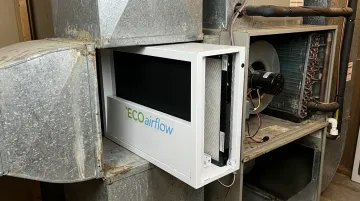
ECOairflow's residential electronic air cleaners use patented Electronic Polarization Technology (EPT) — actively charging airborne particles before capture rather than relying on passive mechanical filtration. The same technology deployed in North American hospitals, airports, and casinos scales directly into residential HVAC systems.
Residential models (Model 1000, Model 1500, Dynamo 1") are rated MERV 11–12 but capture particles down to 0.001–0.007 microns — far below the 0.3-micron floor of standard MERV-rated filters. All carry UL 2998 Zero Ozone Verification and Intertek ETL certification, confirming safety for occupied homes with asthma and respiratory sensitivities.
One practical advantage worth noting for high-MERV shoppers: ECOairflow's low pressure drop (as low as 0.11 in.w.c. for the Dynamo 1") reduces HVAC operating costs by up to 15% compared to dense pleated filters. The permanent housing is a one-time purchase; only the glass-fiber pad needs replacing every 3 months.
| Specification | Detail |
|---|---|
| Rating | MERV 11–12 residential (MERV 13–16 commercial M-Series) |
| Particle capture | Down to 0.001 microns (Model 1000, Dynamo 1"); 0.007 microns (Model 1500) |
| Key features | Patented EPT; UL 2998 Zero Ozone; low pressure drop; reusable permanent frame; ETL listed |
| Best for | Allergy and asthma sufferers wanting maximum ultrafine capture without airflow restriction |
| Replacement | Pad every 3 months; contact ECOairflow for model-specific pricing |
Filterbuy MERV 13 Pleated Filter
Filterbuy is a US-based direct-to-consumer brand offering MERV 13 pleated filters in over 600 standard and custom sizes. For allergy sufferers stuck with an unusual filter dimension, this is often the only practical source for a properly sized high-efficiency option.
The pleated electrostatically charged media captures particles at 50%+ efficiency in the 0.3–1.0 µm range, covering pollen, pet dander, dust mite fragments, mold spores, and some bacteria. A subscription delivery option helps maintain a consistent replacement schedule — one of the most common failure points for allergy filter setups.
| Specification | Detail |
|---|---|
| Rating | MERV 13 |
| Particle capture | ≥50% at 0.3–1.0 µm; ≥85% at 1.0–3.0 µm |
| Key features | 1-inch pleated; 600+ sizes including custom; subscription delivery available |
| Best for | Budget-conscious allergy sufferers needing a drop-in MERV 13 for any standard system |
| Replacement | Every 60–90 days depending on allergen load |
How We Chose the Best Allergy AC Filters
Every filter in this comparison was evaluated against four criteria:
- Filtration efficiency for allergy-relevant particle sizes — pollen, pet dander, dust mite fragments, and mold spores
- Verified ratings under recognized standards, primarily ASHRAE 52.2
- HVAC compatibility — no filter that delivers strong filtration at the cost of damaging airflow restriction
- Total annual cost, factoring in both unit price and replacement frequency
The most common buyer mistake: choosing on MERV number alone without checking system compatibility. A MERV 16 filter installed in a system designed for MERV 8 can cause system strain, higher energy bills, and equipment damage over time.
We weighted third-party certifications heavily — specifically the Asthma & Allergy Friendly® mark from AAFA/ASL, ETL listing, and UL 2998 Zero Ozone Verification. These certifications confirm independently verified performance — not self-reported specifications.
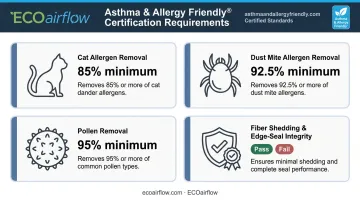
The AAFA/ASL standard sets a clear bar for what qualifies:
- At least 85% cat allergen removal
- At least 92.5% dust mite allergen removal
- At least 95% pollen removal
- Passing tests for fiber shedding and edge-seal integrity
Tips to Get the Most Out of Your Allergy AC Filter
The filter handles airborne particles — but allergens live on surfaces too. Combine your filter upgrade with these habits:
- Vacuum weekly with a vacuum equipped with a high-efficiency filter to avoid resuspending captured particles
- Wash bedding weekly in water at 130°F to kill dust mites at the source
- Keep pets off soft furniture and out of bedrooms to reduce dander concentration where you sleep
- Maintain indoor humidity at 30–50% — above this range, dust mites thrive and mold spores become more prevalent
Beyond the habits above, fit matters as much as rating. A filter that doesn't seat tightly in its housing lets unfiltered air bypass the media entirely — significantly undermining even a MERV 16 filter's performance. Always measure your existing filter or check the system manual before ordering.
Stick to the replacement schedule. A clogged filter increases airflow resistance, strains the blower motor, and reduces capture efficiency over time. During peak pollen season or in homes with multiple pets, replace on a 60-day cycle rather than waiting for the standard 90-day interval.
Frequently Asked Questions
Do allergy AC filters actually work?
Yes — filters rated MERV 11 or higher are proven to reduce airborne concentrations of common allergens including pollen, pet dander, and dust mite fragments. They won't eliminate every allergen in your home, but properly installed and maintained high-MERV filters measurably lower what's circulating through your air.
What is the best air filter for seasonal allergies?
MERV 13 pleated filters or powered electronic filters are the strongest options for seasonal allergy sufferers. For the most reliable pollen capture, look for filters certified Asthma & Allergy Friendly® by AAFA/ASL and independently verified to ASHRAE 52.2 standards.
What MERV rating is best for allergies?
MERV 11–13 is the practical range for most households. MERV 13 achieves minimum 50% efficiency at 0.3–1.0 µm and 85% at 1.0–3.0 µm, covering nearly all common allergens. Powered electronic filters like ECOairflow's residential lineup go further — capturing ultrafine particles below the MERV scale without the airflow penalty of a dense pleated filter.
How often should I change my AC filter if I have allergies?
Replace standard pleated filters every 60–90 days, or monthly during high-pollen seasons and in homes with pets. For powered electronic filters like ECOairflow's residential units, replaceable glass-fiber pads follow a 3-month schedule — the permanent housing never needs replacing.
Can an AC filter help with pet dander and dust mites?
MERV 11 or higher captures pet dander effectively. Dust mite fragments are slightly smaller and benefit most from MERV 13 or electronic filtration. Pair your filter with humidity control — keeping indoor humidity below 50% stops dust mites from reproducing at the source.
Is HEPA better than MERV 13 for home allergy filters?
HEPA captures 99.97% of particles at 0.3 microns, but retrofitting standard residential HVAC ductwork is rarely feasible due to the pressure drop involved. For whole-home use, MERV 13 or a powered electronic filter (such as ECOairflow's EPT-based residential units) delivers more practical allergen control without the airflow penalty.