The wrong filter can strain your HVAC blower, spike your energy bill, or fail to capture the particles that actually matter for your health. According to the EPA, ducted electrostatic precipitators show 60–95% initial single-pass efficiency depending on airflow—a wide range that underscores how much the details matter. This article breaks down exactly how each technology works, where each performs best, and how to make the right call for your specific situation.
Key Takeaways
- Electrostatic filters use electrical charge to attract particles; HEPA uses dense fiber media to physically trap them
- True HEPA removes at least 99.97% of particles at 0.3 microns—the most penetrating particle size
- Electrostatic filters offer dramatically lower pressure drop, reducing HVAC fan energy and operating costs
- HEPA is required in healthcare settings; electrostatic suits general commercial and residential HVAC
- EPT-based electronic air cleaners, such as ECOairflow's product line, deliver high filtration efficiency at a fraction of HEPA's pressure drop
Electrostatic vs. HEPA: Quick Comparison
Here's how the two technologies compare across the factors that matter most to facility managers and homeowners.
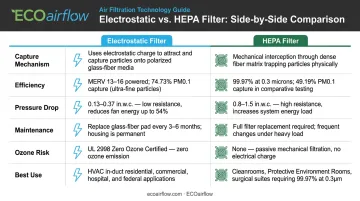
| Factor | Electrostatic | HEPA |
|---|---|---|
| Capture mechanism | Electrical charge attracts particles | Dense fiber matrix physically traps particles |
| Efficiency | 60–95% single-pass (varies by design and maintenance) | 99.97% at 0.3 microns (true HEPA standard) |
| MERV range | Varies by model and test conditions | Separate standard; not directly MERV-equivalent |
| Pressure drop | Very low (as low as 0.11 in.w.c.) | High (89+ Pa initial; often 1–1.5 in.w.g. at end of life) |
| Maintenance | Washable cells or replaceable pads every 1–3 months | Replace every 6–12 months; cannot be washed |
| Ozone risk | Possible with older designs; UL 2998-certified systems emit zero ozone | None |
| Best for | Commercial facilities, hospitals (ASHRAE 170-compliant models), energy efficiency, low-disruption maintenance | Hospitals, allergy/asthma, regulatory compliance |
A note on MERV ratings: ASHRAE 52.2 defines MERV 1–16 for general ventilation filters. HEPA is a separate standard—not "MERV 17+" despite what some product listings suggest. NAFA confirmed in 2023 that MERV 17–20 is not officially recognized under current ASHRAE 52.2.
What Is an Electrostatic Air Filter?
The Two Types You Need to Know
"Electrostatic filter" covers two distinct categories that are often confused:
- Charged media filters — Passive, disposable filters with electrostatically charged fibers. No power required. Limited efficiency improvement over standard pleated filters.
- Electronic air cleaners (EACs) / electrostatic precipitators — Active, powered systems that use high voltage to ionize particles and collect them on charged plates or polarized media.
When comparing electrostatic to HEPA, the relevant technology is the powered EAC category.
How Traditional Electrostatic Precipitators Work
A standard two-stage precipitator charges particles with ionizing wires operating at 6–25 kV, then collects those charged particles on oppositely charged collector plates. The physics mirror a charged balloon attracting dust, scaled up for HVAC airflow volumes.
The catch: efficiency degrades without consistent cleaning. ASHRAE notes that EAC performance remains stable only when maintained through regular cleaning. Skip that step, and fine-particle efficiency can fall below 90% after several hundred hours of operation. Cleaning intervals for residential units typically run every 1–3 months.
The Pressure Drop Advantage
This is where electrostatic technology genuinely outperforms HEPA. Because EACs use open plate structures or low-density mesh rather than dense fiber mats, airflow resistance is substantially lower.
A 2020 peer-reviewed ESP review documented pressure drops as low as 5 Pa per 1,200 m³/h for electrostatic configurations, compared to HEPA filters that commonly reach 89 Pa initial and 1–1.5 in.w.g. at final load. Lower resistance means the HVAC fan works less hard on every cycle, which produces measurable energy savings over time.
Advanced Electrostatic: ECOairflow's EPT Technology
The pressure drop and efficiency trade-offs described above reflect traditional plate-style precipitators. ECOairflow's patented Electronic Polarization Technology (EPT) takes a different approach: instead of separate ionizer and collector stages, EPT generates a polarized electromagnetic field across glass-fiber mesh pads, so each fiber actively captures particles throughout the media depth rather than on surface plates alone.
This depth-capture design directly tackles the two most common criticisms of conventional electrostatic filters: subpar fine-particle efficiency and ozone output. ECOairflow's full product line carries UL 2998 Zero Ozone Certification, and independent lab testing of the commercial Model 2300 showed 74.73% capture of PM0.1 ultra-fine particles, compared to 49.19% for HEPA in the same size range.
What Is a HEPA Air Filter?
The Standard and What It Actually Means
HEPA stands for High Efficiency Particulate Air. The DOE definition, as cited by the EPA, is precise: a true HEPA filter removes at least 99.97% of airborne particles at 0.3 microns. That 0.3-micron figure isn't arbitrary—it's the Most Penetrating Particle Size (MPPS), the size that slips through fiber media most easily. Particles both larger and smaller are actually captured at even higher rates.
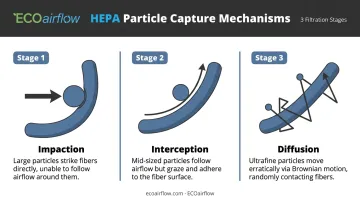
Three mechanisms do the work:
- Impaction — Larger particles can't follow airflow around fibers and collide with them
- Interception — Mid-sized particles following airflow touch a fiber and stick
- Diffusion — Ultrafine particles move erratically (Brownian motion) and contact fibers by chance
"HEPA-type" filters marketed by some manufacturers are not true HEPA and carry no verified efficiency standard—a critical difference when comparing product claims.
Why HEPA Has Real Limitations in HVAC Systems
True HEPA works exceptionally well in standalone air purifiers and dedicated filter housings. Installing it in a standard HVAC system is a different story.
ASHRAE's filtration guidance is direct: HEPA retrofits are usually not feasible in existing HVAC systems because of high pressure drop and the need for specialized sealed racks to prevent bypass. The EPA reinforces this—high-efficiency filters increase airflow resistance, and if the fan can't accommodate it, system performance suffers.
ASHRAE Standard 170 Addendum A adds another hurdle: any HEPA filter or filter rated MERV 14 or higher must have sealing interface surfaces, a requirement most existing systems aren't built to meet.
Healthcare: Where HEPA Is Non-Negotiable
Those limitations don't make HEPA optional in every setting—some environments require it regardless of the tradeoffs.
The CDC requires HEPA filtration at 99.97% efficiency for 0.3-micron particles in protective-environment rooms. This isn't a recommendation—it's a mandatory standard for hospitals managing immunocompromised patients. In these environments, HEPA's certified performance justifies the pressure drop and infrastructure demands.
Maintenance Reality
HEPA filter media cannot be washed. Particles are permanently trapped in the fiber matrix, and accumulated particulate increases pressure drop over time—raising fan energy demand and motor stress.
Key maintenance considerations:
- No washing or regeneration — media must be replaced once loaded
- Monitor pressure drop, not calendar dates, to determine when replacement is due
- Fan demand increases as the filter loads, raising operating costs over time
Which One Works Best? A Decision Framework
There's no universal answer. The right filter depends on four variables:
- What contaminants you need to capture
- Your HVAC system's blower capacity and pressure tolerance
- Your maintenance commitment and budget
- Regulatory or health compliance requirements in your space
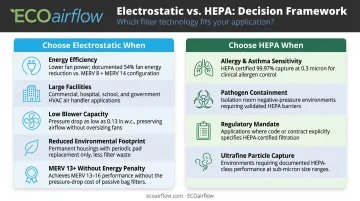
Choose Electrostatic When:
- Energy efficiency is a priority — The lower pressure drop reduces fan energy on every HVAC cycle
- Managing a large commercial facility — Constant filter replacement is disruptive and expensive; electrostatic pads or washable cells reduce that burden
- Your blower can't handle HEPA's pressure drop — A filter the system can't support is worse than a lower-rated filter it can
- Environmental footprint matters — Reusable filter components reduce waste from disposable filter media
- You need MERV 13+ without the energy penalty — Advanced EPT-based systems like ECOairflow's M-Series deliver MERV 13–16A performance at a fraction of HEPA's airflow resistance
Choose HEPA When:
- Occupants include allergy or asthma sufferers — The ACAAI recommends HEPA for residential use where fine particle capture is critical
- The environment involves pathogens — Hospitals, medical offices, and immune-compromised environments require certified 99.97% efficiency
- Regulatory compliance demands documented particle capture — Healthcare protective environment rooms require HEPA by CDC mandate
- Contaminants include ultrafine particles — Wildfire smoke, fine viral aerosols, and black carbon require high-efficiency capture; EPA and AirNow recommend MERV 13+ (or HEPA if compatible) during wildfire events
The Middle Path: Advanced Electronic Filtration
Facilities that need both high efficiency and low pressure drop—hospitals, airports, large commercial buildings—don't have to choose between HEPA's performance and electrostatic's energy advantages. ECOairflow's M-Series Hybrid achieves MERV 13–16A certification under ASHRAE 52.2 Appendix J while operating at just 0.13–0.37 in.w.g. pressure drop.
An independent 12-week hospital study documented a 54% reduction in fan power consumption compared to a traditional ASHRAE 170-compliant MERV 8 pre-filter + MERV 14 bag filter configuration.
For Protective Environment Rooms , the M-Series replaces the energy-intensive MERV 8 + MERV 14 pre-filter stage that sits upstream of HEPA—maintaining full ASHRAE 170 compliance while eliminating the 60%+ fan-energy penalty that pre-filter banks typically carry.
Frequently Asked Questions
Are electrostatic air filters worth it?
For homeowners and commercial facilities prioritizing long-term cost savings and lower HVAC strain, yes—electrostatic filters are worth it. The key condition: consistent cleaning or pad replacement is non-negotiable. Skip maintenance and efficiency drops below acceptable thresholds. They're not the right choice for environments requiring fine particle removal at verified 99.97% efficiency.
Which air purifier is best for COPD?
A true HEPA air purifier is generally recommended for COPD sufferers due to its 99.97% efficiency against fine particulates and respiratory irritants. Zero-ozone-certified electronic filters (UL 2998 verified) can also be appropriate—ozone is a respiratory irritant that can aggravate COPD, so ozone output is an important selection criterion.
Can a HEPA filter be used in a standard HVAC system?
Not without modification in most cases. True HEPA filters carry high pressure drops and typically require specialized sealed racks to prevent bypass. Always verify the system's maximum rated MERV and blower capacity before installing—an incompatible filter reduces airflow and can damage equipment.
Do electrostatic air filters produce ozone?
Traditional electrostatic precipitators can produce ozone as a byproduct of ionization. Advanced certified systems—including all ECOairflow models, which carry UL 2998 Zero Ozone Verification below 0.0005 ppm—are engineered to eliminate ozone output entirely. When evaluating any electronic air cleaner, UL 2998 certification is the standard to look for.
What MERV rating should I look for?
MERV 8–13 suits most residential and commercial applications. Allergy and asthma sufferers benefit from MERV 11–13; healthcare and high-contamination environments typically require MERV 13–16. Always confirm your HVAC system can support the chosen rating before installing—an incompatible filter restricts airflow and can strain the blower motor.
How often should I clean or replace my air filter?
ECOairflow replacement pads follow a quarterly schedule for residential models and every 3–6 months for commercial installations. HEPA filters are typically replaced based on pressure drop monitoring, though 6–12 months is common in lower-load environments. High-traffic or high-contamination facilities will need more frequent servicing regardless of filter type.